
No KYC Casinos UK 2026
Anonymous Gambling Without Verification — Complete Guide for UK Players

Best Non GamStop Casino UK 2026
Loading...
What No KYC Casinos Actually Offer UK Players
Every UKGC-licensed casino will ask for your passport before you see a penny of your winnings. That is not hyperbole. Under current regulations, operators holding a UK Gambling Commission licence must verify your identity, confirm your address, and in many cases run financial vulnerability checks before processing a withdrawal. Since February 2025, those checks kick in once your net deposits cross just 150 pounds in a rolling thirty-day window. For anyone who values privacy or simply resents uploading a selfie next to a utility bill, the process feels less like consumer protection and more like an interrogation.
No KYC casinos exist because that friction drives players elsewhere. The term itself is a shorthand for online gambling platforms that let you register, deposit, play, and withdraw without submitting identity documents. In practice, this means offshore-licensed sites — operators based in jurisdictions like Curaçao, Anjouan, or Costa Rica — where regulatory frameworks either do not mandate document-based identity verification or apply it only at higher thresholds. You sign up with an email address or, increasingly, by connecting a cryptocurrency wallet. No passport scan. No proof of address. No three-day wait while a compliance team reviews your documents.
The appeal is straightforward, but it comes with a trade-off that deserves more than a footnote. These platforms do not hold UKGC licences. That means no access to the UK's alternative dispute resolution schemes, no coverage under GamStop's self-exclusion programme, and no recourse to the Gambling Commission if something goes wrong. You are stepping outside the regulatory perimeter that British gambling law was designed to provide.
This guide is built for players who already understand that trade-off — or want to before they make a deposit. It covers the mechanics behind verification-free gambling, the legal position under UK law, the cryptocurrency payment infrastructure that makes it possible, and the safety precautions that become your responsibility when no regulator is watching. It is not a recommendation. It is a reality check with the technical detail to back it up.
What "no KYC casino" actually means: A no KYC casino is an online gambling platform that does not require players to submit identity documents — such as a passport, driving licence, or proof of address — as a condition of registration, depositing, or withdrawing funds. These sites operate under offshore licences that impose lighter verification requirements than the UKGC. Most accept cryptocurrency exclusively, though some offer fiat payment options through third-party processors. The term "no KYC" does not mean verification will never occur; many platforms reserve the right to request documents at higher withdrawal thresholds or when triggered by unusual account activity.
How Casinos Bypass KYC — The Mechanics
The trick is not a loophole — it is a different jurisdiction with different rules. UKGC-licensed operators must comply with the Gambling Act 2005 and the Commission's Licence Conditions and Codes of Practice, which mandate identity verification as a precondition for virtually every meaningful player interaction. Offshore jurisdictions operate under their own frameworks, and those frameworks were not designed with the same priorities. A Curaçao-licensed operator, for instance, is bound by the rules of the Curaçao Gaming Authority, not the UKGC. And until recently, those rules were remarkably permissive.
The licensing landscape has been shifting. Curaçao completed a major regulatory overhaul between 2023 and 2024, replacing its old master-licence and sub-licence system with a centralised structure under the LOK framework, which entered into force on 24 December 2024. The new Curaçao Gaming Authority now issues licences directly, mandates anti-money laundering policies, and requires alternative dispute resolution. Annual licence fees sit around 47,450 euros for B2C operators. It is more structured than the old regime, but still nowhere near the UKGC's verification requirements. Anjouan, part of the Comoros Islands, and Costa Rica remain further down the regulatory spectrum, offering even lighter oversight and lower barriers to entry for operators.
What these jurisdictions share is a licensing model that does not require operators to collect passport scans, utility bills, or selfie verification from every player at the point of registration. Instead, the infrastructure relies on two alternative approaches: email-based registration and wallet-based authentication.
Wallet-Based Authentication vs Email Signup
Email signup is the simpler model. You provide an email address, set a password, and your account is live. Some platforms skip email entirely and generate an account from a username alone. The barrier to entry is as low as it gets, and fiat payment options — typically processed through third-party e-wallets or crypto purchase services — may be available alongside cryptocurrency deposits.
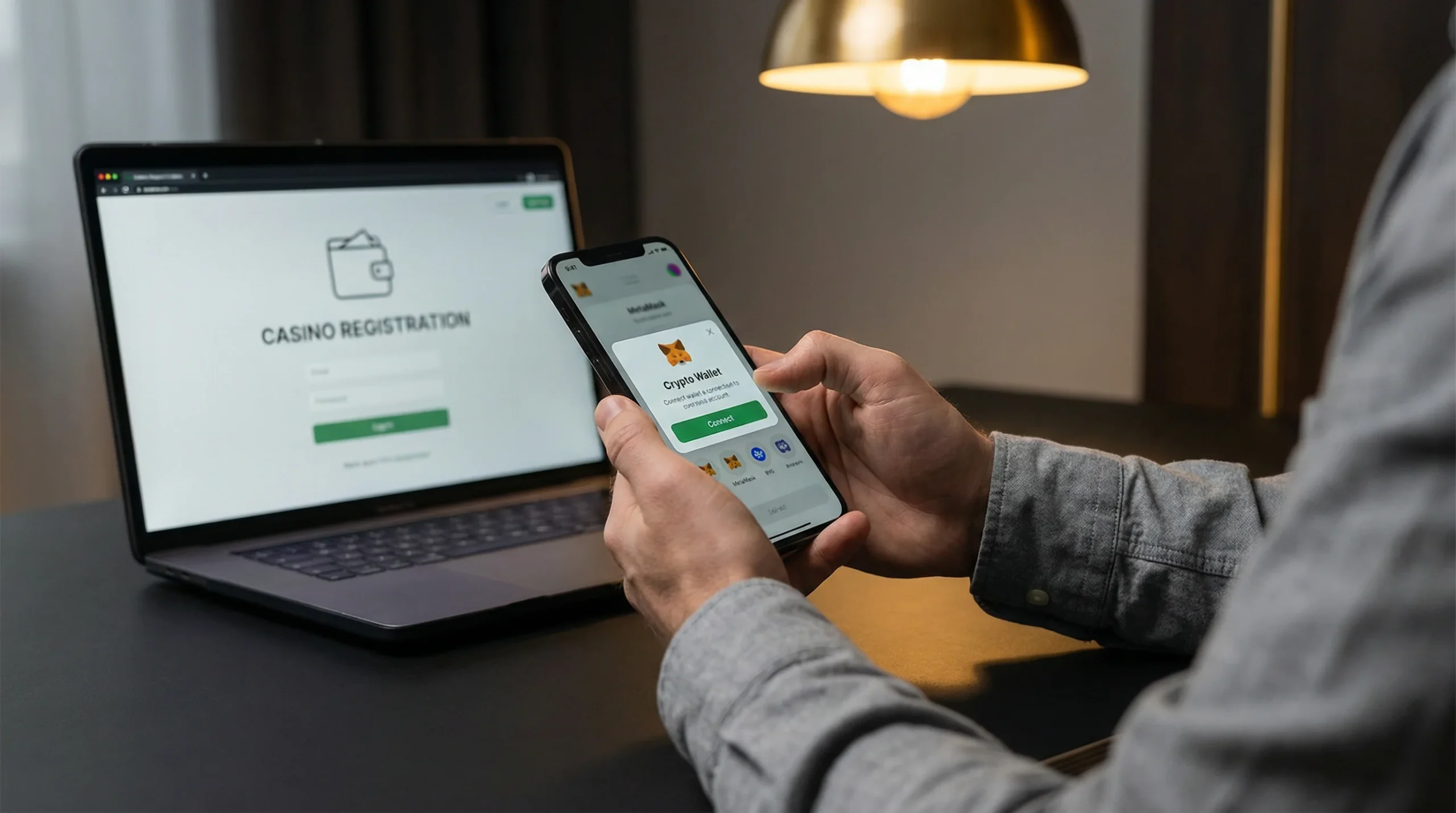
Wallet-based authentication takes a different approach. Instead of creating an account in the traditional sense, you connect a Web3 wallet — MetaMask, Trust Wallet, or a similar non-custodial wallet — directly to the casino platform. Your wallet address serves as your account identifier. No email, no password, no personal data stored on the operator's servers. Authentication happens through cryptographic signature verification: you approve a connection request in your wallet, the platform confirms your public key, and you are in. Deposits and withdrawals flow directly between your wallet and the casino's smart contract or hot wallet address.
The privacy difference is significant. Email registration still creates a data point that can, in theory, be linked back to you. Wallet-based login produces only a blockchain address — a string of characters with no inherent connection to your real-world identity, provided you have not linked that wallet to a KYC-compliant exchange.
Registration flow comparison
UKGC-licensed casino: Email → password → full name → date of birth → address → mobile number → ID document upload → proof of address → manual review (1-72 hours) → account active
No KYC casino (email model): Email → password → account active (under 60 seconds)
No KYC casino (wallet model): Connect wallet → sign authentication message → account active (under 15 seconds)
How Blockchain Verification Replaces ID Checks
At a UKGC casino, identity verification serves two purposes: confirming you are who you say you are, and creating an audit trail for anti-money laundering compliance. Blockchain-based casinos replace the first function entirely and approach the second from a different angle.
Every cryptocurrency transaction is recorded on a public ledger. When you deposit Bitcoin or Ethereum into a casino wallet, that transaction is visible on the blockchain — the amount, the sending address, the receiving address, and the timestamp. The casino does not need to know your name to confirm that the funds arrived. The blockchain itself provides the verification. Withdrawals work the same way in reverse: the casino sends funds to the wallet address you specify, and the transaction is permanently recorded.
This is not total anonymity. Blockchain analysis firms can trace transaction patterns across wallets. If your casino deposit wallet is linked to a centralised exchange where you completed KYC, the chain of custody is theoretically traceable. But for practical purposes, the casino operator never sees your name, address, or date of birth — and has no obligation under its offshore licence to collect that information upfront.
The result is a system where the blockchain provides transactional transparency while the player retains personal privacy. It is a fundamentally different model from the document-based verification that UKGC regulation demands, and it is the technical foundation on which the entire no-KYC casino sector is built.
Legal Reality for UK Players
Not a single crypto casino holds a UKGC licence. Not one. That fact sits at the centre of every legal question about no-KYC gambling in Great Britain, and it shapes everything that follows. The UK's regulatory framework for gambling is one of the most comprehensive in the world, but it was designed for a landscape that no longer fully describes how people gamble online. The result is a grey zone — not because the law is unclear, but because its enforcement has limits that cryptocurrency and offshore hosting were built to exploit.
Understanding where you stand as a player requires separating what the law says from what it does in practice. The two are not the same thing.
What the Gambling Act 2005 Actually Says
The Gambling Act 2005 is the primary legislation governing gambling in England, Wales, and Scotland. Its core mechanism is a licensing requirement: anyone providing gambling facilities to consumers in Great Britain must hold a licence issued by the Gambling Commission. Section 33 makes it an offence to provide facilities for gambling without an appropriate licence, and Section 36 extends its territorial reach so that offshore remote operators can be caught if their facilities are used in Great Britain and they know or should know this is the case. The penalties are serious — up to 51 weeks' imprisonment, a fine, or both.
The critical distinction is that these provisions target operators, not players. There is no criminal offence in the Gambling Act 2005 for an individual player who accesses an unlicensed offshore gambling site. The law was written to regulate supply, not demand. A player who deposits Bitcoin at a Curaçao-licensed casino is not breaking UK law, even though the operator may be in breach of it by accepting UK customers without UKGC authorisation.
That enforcement gap is not accidental. The White Paper published in April 2023, titled "High Stakes: Gambling Reform for the Digital Age," acknowledged the challenges of regulating offshore operators and focused its reform agenda on tightening rules for licensed operators rather than criminalising player behaviour. The subsequent wave of regulatory changes has followed the same logic: make UKGC-licensed platforms safer, stricter, and more transparent, and hope that the regulatory quality gap discourages players from looking elsewhere.
The 2025-2026 reform cycle has been the most aggressive in two decades. Since February 2025, remote operators must run financial vulnerability checks when a customer's net deposits exceed 150 pounds in 30 days. From April 2025, online slot stakes were capped at five pounds per spin for players aged 25 and over, with a two-pound cap for those aged 18 to 24 following in May 2025. A statutory gambling levy came into force in April 2025, with first payments due by October, funded by a percentage of operators' gross gambling yields. And in January 2026, new rules under Social Responsibility Code 5.1.1 reshaped how bonuses and promotions are structured, capping wagering requirements and banning mixed-product promotional offers entirely.
No crypto casino holds a UKGC licence
As of February 2026, the UK Gambling Commission's public register contains no licensed operator that offers cryptocurrency-only gambling or operates without document-based identity verification. Every platform marketed as a "no KYC casino" to UK players is operating under an offshore licence — Curaçao, Anjouan, Costa Rica, or no licence at all. Using these sites is not illegal for players, but it places you entirely outside the UKGC's protective framework.

What This Means If You're the Player
The practical consequences of playing at an unlicensed site are not theoretical. They are structural, and they affect you from the moment you make a deposit.
First, there is no alternative dispute resolution. UKGC-licensed operators must participate in approved ADR schemes — independent bodies that adjudicate complaints between players and casinos. If a licensed casino refuses to pay a legitimate withdrawal, you can escalate. At an offshore casino, your complaint is a suggestion, not a demand. The operator's internal complaint process is the only formal channel, and its outcomes are not binding in any UK jurisdiction.
Second, GamStop does not apply. The self-exclusion scheme that covers all UKGC-licensed gambling sites has no reach over offshore operators. If you have registered with GamStop and still want to gamble, a no-KYC casino will not stop you. For some players, that is the point. For others, particularly those managing gambling-related harm, it is a dangerous gap.
Third, your funds are not protected. UKGC-licensed operators are required to disclose how customer funds are held in the event of insolvency and, since October 2025, must remind players every six months if those funds are classified as "not protected." Offshore operators have no such obligation. If a Curaçao-licensed casino shuts down tomorrow, your balance goes with it. There is no compensation fund and no regulatory body with the authority or inclination to recover your money.
None of this makes playing at a no-KYC casino illegal. It makes it unprotected. The distinction matters, and it is one that every player should understand before they connect a wallet or type in an email address.
What Sets the Best No KYC Casinos Apart
A casino that takes 48 hours to process a Bitcoin withdrawal has no business calling itself instant. And yet the label gets applied liberally across the no-KYC sector, alongside other claims that range from optimistic to fictional. When every platform is competing for the same audience with the same adjectives — fast, anonymous, fair — the real differentiators are buried in the operational details. Evaluating a no-KYC casino requires a framework, not a feeling.
The absence of UKGC oversight means there is no standardised quality floor. A Curaçao-licensed casino and an unlicensed one can look identical from the landing page. The distinction shows up in withdrawal processing, game library depth, bonus terms, and — most importantly — whether the operator actually pays out when you win. Below are the criteria that separate serious platforms from marketing exercises.
Licensing and Transparency
A visible licence number from a recognised offshore jurisdiction — Curaçao, Anjouan, Kahnawake — is the baseline. Verify it on the regulator's public register. Operators that display no licence information, or show a number that does not match any registry, are operating without oversight. Under Curaçao's reformed LOK framework, all licensed operators now appear in a centralised public register maintained by the Curaçao Gaming Authority.
Withdrawal Speed and Reliability
The metric that matters most. Crypto withdrawals at well-run no-KYC platforms process in under ten minutes. Some complete in under sixty seconds. If a casino consistently takes more than an hour for a standard Bitcoin or Litecoin withdrawal — or imposes unexplained "security reviews" — that is a red flag. Test with a small withdrawal before committing larger amounts.
Game Library and Provider Quality
The best anonymous casinos offer libraries exceeding five thousand titles from established providers — Pragmatic Play, Evolution, Play'n GO, Hacksaw Gaming. A thin library or exclusive reliance on obscure in-house games suggests a platform that cannot attract reputable suppliers. Provider diversity is a proxy for operator credibility.
Bonus Fairness and Wagering Terms
Welcome bonuses at no-KYC casinos typically range from 100 to 400 percent match deposits. The number that matters is the wagering multiplier. Anything at or below 35x is reasonable. Between 35x and 45x requires caution. Above 45x, the expected value turns negative for most players. The January 2026 UKGC reforms capped wagering requirements at 10x for licensed operators — a benchmark that makes offshore bonus terms look even more aggressive by comparison.
Cryptocurrency Variety
Bitcoin acceptance is standard. The better platforms also support Ethereum, Litecoin, Dogecoin, USDT, USDC, and increasingly Solana and Tron-based tokens. Stablecoin support matters for players who want to avoid the volatility risk of depositing in BTC or ETH. Platforms that accept only Bitcoin are functional but limited.
Reputation and Community Standing
Trustpilot scores, forum sentiment on communities like BitcoinTalk and Reddit, and complaint patterns over time. A casino with a 4.0 Trustpilot rating and hundreds of reviews signals something different from one with a 4.8 rating and twelve reviews. Look for patterns in negative reviews — delayed withdrawals, confiscated balances, and unresponsive support are the recurring themes at problematic operators.
No single criterion is sufficient. A fast-paying casino with no licence is still a risk. A licensed casino with 50x wagering requirements is still extracting more from bonuses than it gives. The framework works when applied as a whole — each metric filling the gaps that the others leave open.
Crypto Banking at Anonymous Casinos
Bitcoin is the standard. Everything else is a trade-off between speed, cost, and privacy. That hierarchy has held true since the earliest crypto casinos appeared, and it still defines how the payment landscape works at no-KYC platforms in 2026. The reason is simple: Bitcoin has the widest acceptance, the deepest liquidity, and the longest track record in the anonymous gambling sector. But it is not always the smartest choice for every transaction, and the alternatives have matured enough to deserve serious consideration.
Fiat currency is functionally absent from the no-KYC ecosystem. Some platforms offer fiat deposit options through third-party processors or crypto purchase widgets, but every one of those channels creates a paper trail. A debit card deposit ties your name to your bet. A bank transfer is even worse. The entire value proposition of verification-free gambling collapses the moment you introduce a regulated payment method. Cryptocurrency is not a preference at these platforms — it is an architectural requirement.
Bitcoin and Lightning Network Payments
On-chain Bitcoin transactions remain the most common deposit and withdrawal method at anonymous casinos. The process is straightforward: copy the casino's deposit address, send BTC from your wallet, wait for the required number of confirmations — typically one to three — and your balance appears. Withdrawals reverse the flow. The entire cycle can complete in ten to thirty minutes under normal network conditions.
The bottleneck is the Bitcoin mempool. When transaction volume spikes, mining fees rise and confirmation times stretch. A transaction that costs two dollars in fees on a quiet Tuesday might cost fifteen on a congested Saturday evening. For players making frequent small deposits, those fees erode value quickly.
The Lightning Network addresses this directly. It is a second-layer protocol built on top of Bitcoin that enables near-instant transactions at fractional cost — often under a penny. A growing number of no-KYC casinos now support Lightning deposits and withdrawals, and for players moving amounts under a few hundred pounds, it is the superior option. Deposits confirm in seconds rather than minutes. Fees are negligible. The trade-off is adoption: not every platform supports it yet, and Lightning capacity limits mean very large transactions may still need to settle on the main chain.
Ethereum, Stablecoins, and Altcoin Options
Ethereum offers smart contract programmability that Bitcoin lacks, but its main-chain gas fees remain a persistent annoyance. A simple ETH transfer might cost three to ten dollars depending on network congestion, and interacting with a smart contract can push that higher. For players depositing under fifty pounds, Ethereum on Layer 1 is inefficient. Layer 2 solutions like Arbitrum reduce costs significantly, though casino support for these networks is still limited.
Stablecoins solve the volatility problem entirely. USDT and USDC are pegged to the US dollar, meaning a deposit of 100 USDT today will still be worth approximately 100 dollars when you withdraw it next week. For Bitcoin or Ethereum deposits, that is never guaranteed — a 5 percent price swing during a weekend session can change your effective balance without a single bet being placed. Most no-KYC casinos accept USDT on the Tron (TRC-20) network, where transaction fees are minimal, or on Ethereum (ERC-20), where fees are higher but liquidity is deeper.
Litecoin and Dogecoin occupy the low-fee, fast-confirmation niche. Litecoin transactions typically confirm in two to three minutes with fees under a penny. Dogecoin is similarly quick and cheap. Neither offers the privacy advantages of Bitcoin with a mixer or the programmability of Ethereum, but for straightforward deposits and withdrawals with minimal friction, they are hard to beat.
Bitcoin (BTC)
Confirmation: 10-30 min (on-chain), seconds (Lightning). Fee: variable, typically 1-15 GBP. Privacy: pseudonymous. Acceptance: near-universal.
Ethereum (ETH)
Confirmation: 2-5 min. Fee: 3-10 GBP (Layer 1), under 0.50 GBP (Layer 2). Privacy: pseudonymous, traceable. Acceptance: wide.
USDT (Tether)
Confirmation: seconds (TRC-20), 2-5 min (ERC-20). Fee: under 1 GBP (TRC-20), 3-10 GBP (ERC-20). Privacy: pseudonymous. Acceptance: growing rapidly.
Litecoin (LTC)
Confirmation: 2-3 min. Fee: under 0.05 GBP. Privacy: pseudonymous. Acceptance: moderate to wide.

What Triggers KYC at a "No-Verification" Casino
The banner says "no verification." The terms and conditions say something different. This is perhaps the most important gap between marketing and reality in the entire no-KYC casino sector, and it catches players off guard at exactly the wrong moment — when they are trying to withdraw their winnings.
The phrase "no KYC" is accurate as a description of the registration process. You can sign up without documents. You can deposit without documents. You can play for weeks without anyone asking who you are. But most offshore-licensed casinos reserve the right to request identity verification at their discretion, and that discretion is usually triggered by specific events — almost all of which involve money leaving the platform.
Withdrawal thresholds are the most common trigger. The exact numbers vary by operator, but the pattern is consistent: withdrawals above a certain amount — typically between 2,000 and 5,000 dollars in equivalent value — activate a manual review process. At that point, the casino may request a government-issued ID, proof of address, or even a selfie holding your document. The threshold is rarely published on the marketing pages. It lives in the terms and conditions, often buried in a section labelled "security procedures" or "account verification."
Unusual deposit patterns also draw attention. Depositing and withdrawing without significant play — sometimes called "chip dumping" or "pass-through" behaviour — flags anti-money laundering systems, even at loosely regulated platforms. Curaçao's reformed licensing framework now mandates AML compliance, which means even offshore operators are under increasing pressure to monitor transaction patterns. Rapid deposits from multiple wallets, followed by an immediate withdrawal request, will almost certainly trigger a review.
Multi-account detection is another vector. Operators track IP addresses, browser fingerprints, and wallet addresses to identify players running multiple accounts. If caught, the standard response is account closure and balance confiscation — and the terms will support the operator's right to do this. VPN use compounds the risk: getting flagged does not always trigger KYC, but it can trigger account suspension, particularly when combined with a large withdrawal.
Bonus abuse rounds out the list. Operators track wagering patterns suggesting a player is exploiting promotional offers — creating new accounts for repeated welcome bonuses, using low-risk strategies to clear wagering, or coordinating across accounts. These patterns trigger manual reviews faster than almost anything else, because they directly hit the operator's margin.
Do
- Read the terms and conditions before depositing — specifically the sections on verification, withdrawal limits, and account security
- Test with a small withdrawal first to confirm the process works before committing larger sums
- Use a single, consistent wallet address for deposits and withdrawals at each platform
- Keep records of every transaction, including blockchain transaction IDs and screenshots
- Spread larger withdrawals across multiple requests if the platform imposes per-transaction limits
Don't
- Assume "no KYC" means verification will never be requested — it means it is not required upfront
- Deposit from multiple unrelated wallets or switch wallet addresses without reason
- Attempt to run multiple accounts at the same platform to claim bonuses more than once
- Ignore withdrawal caps — exceeding published limits in a single request is a reliable KYC trigger
- Deposit and withdraw without playing, as pass-through behaviour flags AML monitoring systems
The underlying principle is simple: "no KYC" describes the front door. It does not describe what happens when you try to leave with a large sum. Every player at an anonymous casino should operate under the assumption that verification is deferred, not eliminated.
Provably Fair Games — Can You Actually Verify Outcomes?
Provably fair means you can audit the maths — not that the house does not have an edge. The distinction matters, because the phrase gets used as a marketing tool far more often than it gets used as an actual verification mechanism. In principle, provably fair technology is one of the most compelling innovations in online gambling. In practice, its application is narrower than the branding suggests.
The system works through cryptographic hashing. Before a game round begins, the casino server generates a seed — a random string of characters — and hashes it using a one-way cryptographic function, typically SHA-256. The hashed version of this server seed is shown to the player before the round starts. The player can also provide their own client seed, or the platform generates one automatically. A nonce — a sequential counter that increments with each bet — is added to prevent repetition. The combination of server seed, client seed, and nonce determines the game outcome through a mathematical formula that is publicly documented.
After the round concludes, the server reveals the unhashed seed. You can then take that seed, combine it with your client seed and the nonce, run it through the same formula, and verify that the outcome matches what the casino displayed. If it does, the result was determined before you placed your bet and was not manipulated after the fact. If it does not, the casino cheated — and you have cryptographic proof.
The limitation is scope. Provably fair verification works only on games where the casino controls the random number generation directly. This means in-house original games — dice, crash, mines, plinko, coin flip, and similar titles built on the platform's own engine. It does not apply to third-party slots, live dealer games, or table games provided by external studios like Pragmatic Play or Evolution. Those games use their own RNG systems, certified by independent testing labs, and the casino platform has no access to the underlying seed data.
This is where the marketing outpaces the reality. A casino can advertise itself as "provably fair" while only a fraction of its library — perhaps the twenty or thirty original titles — actually supports hash verification. The remaining three thousand slots and live games operate on the same trust model as any other online casino: you trust the provider's RNG certification and the testing lab's audit. Provably fair does not extend a transparency umbrella over the entire platform.
The SHA-256 hash function used in most provably fair systems is the same algorithm that secures Bitcoin's blockchain. A single character change in the input produces an entirely different hash output, making it computationally impossible for a casino to reverse-engineer a desired result after the player's seed has been submitted.
For players who want to use the verification mechanism, the process is straightforward but rarely automated in a user-friendly way. Most provably fair casinos provide a verification page where you can paste the server seed, client seed, and nonce to recalculate the result. Some link to open-source verification tools on GitHub. In practice, fewer than five percent of players ever verify a result — but the option exists, and for mathematically inclined gamblers, it provides a level of trust that no third-party audit can match.
Staying Safe Without a Regulator Watching
When there is no regulator to complain to, due diligence is your only insurance policy. That sentence should inform every decision you make at a no-KYC casino, from the moment you choose a platform to the moment you withdraw your last satoshi. The UKGC's role is not just punitive — it establishes operational standards that players at licensed sites can take for granted: segregated funds, complaint escalation, mandatory responsible gambling tools, and the knowledge that an operator's licence is at stake if they behave badly. At an offshore casino without verification, every one of those protections becomes your personal responsibility.
This is not a reason to avoid no-KYC platforms entirely. It is a reason to approach them with the same discipline you would apply to any financial decision where the safety net has been removed.
Red Flags That Should Make You Walk Away
If the terms of service contain the word "confiscation," close the tab. This is not a figure of speech. Some offshore casinos include clauses that permit the operator to confiscate your balance under vaguely defined conditions — "security concerns," "suspected bonus abuse," "violation of platform rules." The language is deliberately broad, and at an unlicensed or loosely regulated site, there is no external body to challenge the operator's interpretation.
Other warning signs are structural. A casino that displays no licence information — not even an offshore one — is operating entirely outside any regulatory framework. Copy-paste terms and conditions lifted verbatim from another site suggest an operator that invested more in the marketing page than the legal infrastructure. Phantom support teams are another tell: send a pre-deposit enquiry through live chat. If no one responds within 24 hours, imagine how responsive they will be when you have a withdrawal dispute.
Social media absence is a subtler signal. Legitimate operators, even offshore ones, maintain active Telegram channels, X accounts, or Discord servers. These serve as community hubs and, critically, as public accountability channels. A casino with no social media presence and no community footprint has no public reputation to protect — and reputation is one of the few constraints that applies to operators outside UKGC jurisdiction.
Trustpilot reviews deserve scrutiny, not blind trust. A cluster of five-star reviews posted within the same week, all praising "amazing bonuses" in similar language, suggests astroturfing. A mix of ratings with detailed negative reviews — "my withdrawal was delayed for six days and support stopped responding" — provides more useful intelligence than any marketing page.
Setting Your Own Limits Without GamStop
GamStop will not help here. The self-exclusion programme operates only across UKGC-licensed platforms, and no offshore casino participates. If you have a GamStop registration and are considering a no-KYC casino precisely because it falls outside that scheme, this section is especially important — and it asks you to be honest with yourself about why.
Self-regulation at verification-free platforms requires manual discipline and, ideally, external tools. Start with deposit limits. Some no-KYC casinos offer built-in deposit cap settings — use them if they exist, but verify that they actually function by testing with a deposit that exceeds your set limit. Not all platforms implement these tools reliably.
External blocking software provides a harder barrier. Gamban is a paid service that blocks access to thousands of gambling sites, including many offshore platforms. BetBlocker is a free alternative maintained by a registered charity that covers a similar range. Both work at the device level, applying restrictions across browsers and apps. Neither is perfect — determined users can circumvent them — but they add friction to impulsive decisions, and friction is the single most effective harm-reduction tool in gambling.
Session time awareness matters more than most players acknowledge. Set a timer on your phone before you start playing. When it goes off, stop. Not "finish this round." Stop. The absence of regulatory session-time prompts — which UKGC-licensed sites are required to provide — means the platform has no incentive to remind you how long you have been playing or how much you have spent. That burden falls entirely on you.
Five-step safety check before depositing at any no-KYC casino
- Verify the licence number on the regulator's public register — Curaçao Gaming Authority, Anjouan Gaming Commission, or equivalent
- Read the terms and conditions, focusing on withdrawal limits, verification triggers, and confiscation clauses
- Send a test message to live chat support and evaluate response time and quality
- Search the casino name on Trustpilot, Reddit, and BitcoinTalk for withdrawal complaints and payout reliability
- Make a small test deposit and withdrawal before committing any significant amount

Bonuses at No KYC Casinos — What's Real, What's Bait
A 500% bonus with 60x wagering is not generous — it is a retention mechanism. The maths are not complicated, but they are routinely ignored by players dazzled by headline percentages. No-KYC casinos compete aggressively on bonuses because they cannot compete on institutional trust. A UKGC-licensed operator can lean on its regulatory status as a credibility signal. An anonymous offshore casino needs to offer you something tangible to earn your deposit — and that something is almost always a match bonus that looks extraordinary until you read the conditions attached to it.
Welcome packages at verification-free platforms typically range from 100 to 400 percent across one to four deposits. A 200 percent match up to 1,000 pounds sounds generous. But if the wagering requirement is 40x, you need to bet 40,000 pounds before you can withdraw any bonus-derived winnings. At a house edge of 3 to 5 percent on slots — the only game category that typically contributes 100 percent toward wagering — your expected loss across that play-through is 1,200 to 2,000 pounds. The bonus has negative expected value. You are statistically likely to lose more clearing the wagering than the bonus was worth.
Wagering below 35x shifts the maths in a more favourable direction, and a handful of no-KYC platforms offer requirements in the 25x to 30x range. At those levels, the expected loss during play-through is smaller, and variance gives you a reasonable chance of emerging ahead. But these offers are the exception. The median wagering requirement across the offshore casino sector sits between 35x and 45x, and outliers above 50x are not uncommon.
The January 2026 UKGC reforms provide a stark contrast. Licensed operators must now cap wagering requirements at 10x and provide mandatory wagering calculators that show players exactly how much they need to bet in monetary terms before bonus funds become withdrawable. Mixed-product bonuses — requiring you to bet on sports to unlock casino free spins, for example — have been banned entirely. These rules do not apply to offshore casinos, which means the gap between UKGC-regulated bonus terms and no-KYC bonus terms has widened dramatically.
Cashback and rakeback programmes represent a different value structure. Cashback returns a percentage of net losses — typically 5 to 15 percent — credited daily or weekly. Rakeback returns a percentage of total wagered amount regardless of outcome, usually 3 to 10 percent. Both provide ongoing value rather than a one-time deposit boost, and both are harder to manipulate through fine print. A 10 percent weekly cashback with no wagering requirement on the returned funds is often worth more, over time, than a 200 percent welcome bonus with 40x play-through.
Free spins and no-deposit bonuses are rare at no-KYC casinos and come with stringent terms — typically 50x wagering and a withdrawal cap of 50 dollars. Treat them as a way to test the platform, not as genuine rewards.
The evaluation framework is simple. Check the wagering multiplier. Check the game contribution rates — if table games contribute only 10 percent, a 40x wagering requirement effectively becomes 400x for blackjack players. Check the time limit — most bonuses expire within 7 to 30 days. Check the maximum bet rule — exceeding it voids your bonus and any winnings derived from it. If any of these conditions are absent from the terms, ask support in writing. If they cannot answer clearly, do not take the bonus.
Bonuses get players through the door. The next section addresses the questions that keep them up at night.
Frequently Asked Questions
Are no KYC casinos legal in the UK?
The Gambling Act 2005 requires operators to hold a UKGC licence to legally offer gambling services to players in Great Britain, and no crypto casino currently holds one. However, the Act targets operators, not players. There is no criminal offence for an individual who accesses an offshore gambling site without UKGC licensing. The practical consequence is not illegality but a loss of protection: players at unlicensed sites have no access to UKGC dispute resolution, GamStop self-exclusion, or the compensation frameworks that apply to licensed operators. You are not breaking the law, but you are stepping outside every safety mechanism that UK gambling regulation provides.
What triggers KYC checks at crypto casinos?
Most no-KYC casinos reserve the right to request identity verification under specific conditions, even if none is required at registration. The most common trigger is a withdrawal above a certain threshold — typically between 2,000 and 5,000 dollars in equivalent value. Other triggers include unusual deposit patterns such as rapid deposits from multiple wallets, suspected multi-accounting, VPN detection, and behaviour consistent with bonus abuse. Anti-money laundering obligations, which now apply under reformed offshore frameworks like Curaçao's LOK system, have increased the likelihood of verification at the payout stage. The practical advice is to read the terms and conditions before depositing and test with a small withdrawal first.
What happens if a no KYC casino refuses to pay out?
Without a UKGC licence, there is no alternative dispute resolution scheme and no ombudsman to escalate to. Your first recourse is the casino's internal complaint process, which is rarely binding and often slow. If that fails, community pressure through forums like BitcoinTalk, Reddit, and casino-focused Telegram groups can sometimes force a resolution — operators with a public reputation have an incentive to resolve disputes visibly. Curaçao-licensed operators are now required to offer ADR under the new LOK framework, though the effectiveness of these mechanisms remains untested at scale. As a last resort, blockchain transaction records provide verifiable evidence of deposits and withdrawals, which can support a claim — but there is no court of practical jurisdiction for most offshore disputes.
The Privacy Premium — What You're Actually Trading
Privacy has a price. At a no-KYC casino, you are the one paying it.
The transaction is not complicated, but it is rarely stated plainly. When you choose an anonymous gambling platform over a UKGC-licensed alternative, you gain speed — no document uploads, no waiting periods, no compliance team reviewing your withdrawal at half past three on a Wednesday. You gain privacy — no passport scans sitting on a corporate server, no financial vulnerability checks probing your spending patterns, no mandatory deposit prompts reminding you of limits you did not ask for. And you gain access — to platforms, games, and bonus structures that operate outside the increasingly tight perimeter of UK gambling regulation.
What you trade for those advantages is protection. Not theoretical protection. Concrete, operational mechanisms that exist specifically for the moments when things go wrong. Dispute resolution. Insolvency safeguards. Self-exclusion programmes that actually prevent you from gambling when you have decided you should not be. A regulatory body with the authority and the mandate to investigate operators who behave badly. At a UKGC casino, those mechanisms are imperfect but real. At a no-KYC casino, they do not exist.

The players who navigate this trade-off successfully share a few characteristics. They understand the legal position and accept the regulatory void without illusions. They treat every platform as unproven until it has processed multiple withdrawals. They never deposit more than they can afford to lose — not as a platitude, but as an operational rule. They use external tools to manage their gambling behaviour because the platform will not do it for them. And they keep records, because the blockchain remembers every transaction even if the casino would prefer to forget.
No-KYC gambling is not for everyone. It is not even for most people. For experienced players who understand what they are opting out of and have the self-discipline to manage the risks, it offers a faster, more private alternative to the increasingly friction-heavy experience at regulated UK sites. For anyone else — particularly anyone with a history of problem gambling or a tendency to chase losses — the absence of external safeguards is not a feature. It is a hazard.
The best test of any casino is not the deposit. It is whether they let you withdraw. Apply that test early. Apply it often. And understand that in the world of anonymous gambling, trust is not given by a licence. It is earned one payout at a time.