
Litecoin and Dogecoin No KYC Casinos 2026
 Available in GB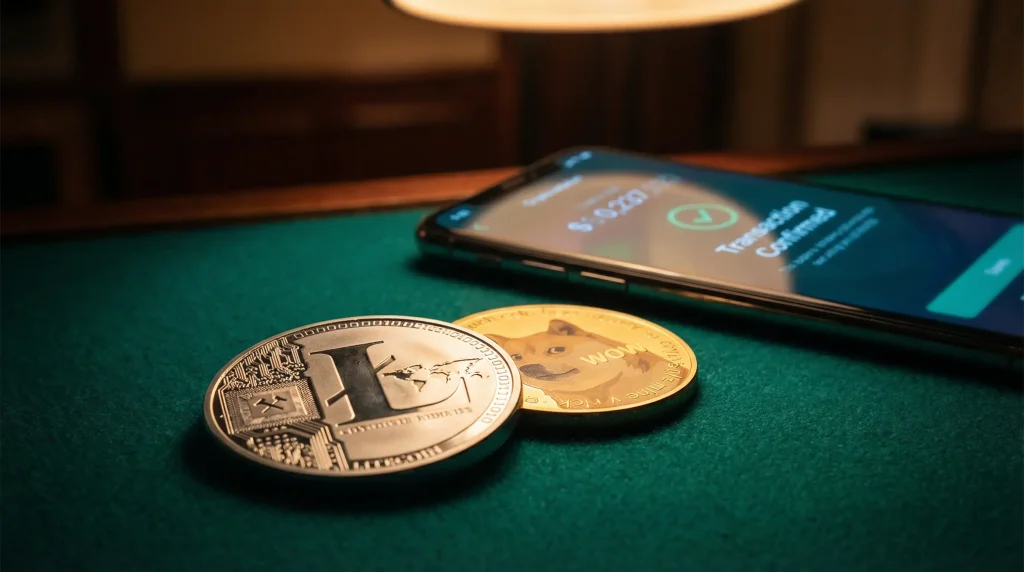
Beyond Bitcoin and Ethereum
Bitcoin gets the headlines. Ethereum gets the think pieces. Litecoin and Dogecoin get overlooked — and that’s precisely why they’re worth examining as payment options at no-KYC casinos. Neither coin dominates the anonymous gambling conversation, but both fill specific roles that the two market leaders don’t serve as efficiently.
Litecoin was designed as a faster, cheaper alternative to Bitcoin (Fidelity Digital Assets). It confirms transactions in roughly two and a half minutes instead of ten, charges lower network fees, and has been accepted at crypto casinos for nearly as long as Bitcoin itself. Dogecoin started as a joke, evolved into a community-driven phenomenon, and now functions as a legitimate micro-transaction currency accepted at a growing number of no-verification platforms. Neither coin will replace BTC or ETH at the centre of crypto gambling. Both occupy niches where they outperform the bigger names on specific metrics that matter to casino players.
For UK players evaluating payment options at anonymous casinos, the choice between cryptocurrencies is rarely either/or. Most platforms accept multiple coins, and using Litecoin for one deposit and Bitcoin for another costs nothing extra. The question is when each coin makes practical sense — which situations favour LTC’s speed, which favour DOGE’s low minimums, and when sticking with Bitcoin remains the simpler path. This guide breaks down both coins as casino payment methods, compares them against the market leaders, and identifies the scenarios where the underdogs earn their place.
Our top casino picks for the UK
- ZombillionBonus: Welcome Pack 250% up to £4000 + 200 FS · Payout speed: 1-3 business days
- SlotoSportBonus: 500% up to £ 10 200+ 777 FS · Payout speed: 1-3 business days
- NightWinBonus: £900 + 400 free spins · Payout speed: 1-3 business days
- DieselwinBonus: Welcome Pack 250% up to £4000 + 200 FS · Payout speed: 1-3 business days
- SpinFormulaBonus: 550% Up To £15,000 + 550 FS · Payout speed: 1-3 business days
- NightLuckBonus: Welcome Pack + 805% Up To 6400€ + 280 FS · Payout speed: 1-3 business days
- JetsetspinsBonus: 200% Bonus + 100 Free Spins + Free Royal Wheel · Payout speed: 1-3 business days
- BritsinoBonus: Welcome Package – Get your £2,200 + 2,000 FS · Payout speed: 1-3 business days
Litecoin — The Speed Play
Litecoin processes blocks every two and a half minutes, compared to Bitcoin’s ten (Litecoin.com). In casino terms, that means an on-chain LTC deposit typically confirms in under five minutes — fast enough to feel nearly instant without requiring the Layer 2 infrastructure that Bitcoin depends on for comparable speed. If a no-KYC casino doesn’t support Lightning Network and you need your deposit credited quickly, Litecoin is the most reliable alternative.
Network fees reinforce the speed advantage. A standard Litecoin transaction costs a fraction of a penny under normal conditions. Even during periods of elevated network activity — which occur less frequently on Litecoin than on Bitcoin or Ethereum — fees rarely climb above a few pence. For players who make frequent deposits and withdrawals, the cumulative fee savings over dozens of transactions are real, if individually small. Compare this to Ethereum gas during a congested period, where a single transaction can cost several pounds, and the economic argument for LTC as a casino payment method sharpens considerably.
Acceptance at no-KYC casinos is broad but not universal. Litecoin sits in the second tier of cryptocurrency support: behind Bitcoin and the major stablecoins, roughly level with Ethereum, and ahead of niche altcoins like Solana or Ripple. Most well-established anonymous casinos accept LTC. Smaller or newer platforms may not. If Litecoin is your preferred payment method, checking the casino’s deposit page before registering takes ten seconds and saves you the frustration of discovering unsupported coins after the fact.
One characteristic of Litecoin that appeals to privacy-conscious players: its blockchain, while public like Bitcoin’s, receives considerably less attention from blockchain analysis firms. The volume of commercial surveillance tooling dedicated to tracing Litecoin transactions is a fraction of what exists for Bitcoin. This doesn’t make LTC anonymous — it’s pseudonymous, same as BTC — but it reduces the likelihood that a casual observer or an off-the-shelf analysis tool can link your casino transactions to other activity on the network. For players who treat pseudonymity as a spectrum rather than a binary, that marginal improvement has value.
Litecoin’s primary limitation as a casino currency is volatility. Like Bitcoin, its price fluctuates against fiat currencies, meaning the value of your deposit can change between the time you send it and the time you withdraw. The magnitude of these swings is comparable to Bitcoin’s in percentage terms. Players who want the speed and low fees of Litecoin without the volatility exposure can deposit in LTC and, at casinos that support it, convert to a stablecoin balance for play — capturing the benefits of LTC’s transaction efficiency while eliminating price risk during the session.
Dogecoin — From Meme to Payment Method
Dogecoin’s origin as a joke currency created in 2013 (Dogecoin.com) has been thoroughly documented and just as thoroughly eclipsed by what it became. The Shiba Inu-branded coin developed a community larger and more engaged than most serious cryptocurrency projects, attracted high-profile attention that pushed its market capitalisation into the billions, and established itself as a functional payment network with transaction speeds and fees that make it genuinely useful for small-value transfers.
At no-KYC casinos, Dogecoin occupies the micro-transaction niche. A DOGE transaction confirms in about a minute (OKX) and costs a negligible fraction of a penny. For players who want to deposit small amounts — five, ten, twenty pounds’ worth of crypto — Dogecoin’s fee structure means virtually nothing is lost to transaction costs. Compare that to an on-chain Bitcoin deposit of ten pounds where the network fee might consume fifty pence or more, and the proportional advantage of DOGE for small deposits is clear.
The coin’s low individual unit price (typically measured in pence rather than pounds) creates a psychological framing that some players find appealing. Depositing five thousand DOGE feels different from depositing 0.0003 BTC, even when both represent the same pound value. This is entirely cosmetic — the casino converts to an internal balance regardless — but the sense of handling whole numbers rather than decimal fragments contributes to Dogecoin’s popularity among casual gamblers who find Bitcoin’s decimal notation unintuitive.
Acceptance is more limited than Litecoin’s. Dogecoin appears at many of the larger no-KYC casinos, particularly those built on multi-currency platforms, but it’s less commonly supported than BTC, ETH, USDT, or LTC. Platforms that do accept DOGE typically process it smoothly — the blockchain infrastructure is mature and reliable — but the bonuses and promotional structures are less likely to be denominated in Dogecoin specifically. Expect to see bonus offers quoted in BTC or USD, with DOGE deposits converted at the prevailing exchange rate.
Volatility is Dogecoin’s most significant drawback as a casino currency. DOGE’s price is more volatile than Bitcoin’s in percentage terms, and it’s more susceptible to sudden swings driven by social media activity or celebrity commentary. A deposit of five thousand DOGE could lose ten percent of its fiat value in a single day during a sell-off, or gain twenty percent during a rally. For players who deposit and withdraw within a short session, the exposure is limited. For those who leave a balance sitting in a casino account for days or weeks, DOGE’s price volatility represents an additional and uncontrollable risk layered on top of the gambling itself.
When Altcoins Make More Sense Than Bitcoin
The case for Litecoin or Dogecoin over Bitcoin at a no-KYC casino reduces to three scenarios where the smaller coins perform better on metrics that directly affect the gambling experience.
Small deposits are the clearest case. When the amount you’re sending is under fifty pounds, Bitcoin’s on-chain network fee represents a meaningful percentage of the transaction. Litecoin and Dogecoin both cost virtually nothing to send, keeping the full deposit value available for play. If the casino supports Lightning Network, Bitcoin closes this gap entirely — but if it doesn’t, LTC and DOGE win on pure economics for low-value transfers.
Speed without Lightning is the second scenario. A casino that accepts Bitcoin only on-chain means a ten-to-thirty-minute wait for deposit confirmation. Litecoin confirms in under five minutes, and Dogecoin in about a minute. For players who want to top up their balance quickly during an active session — adding funds for a live blackjack hand or chasing a bonus timer — the altcoins offer a material speed advantage at casinos that haven’t implemented Bitcoin’s faster payment layers.
Portfolio diversification is a more niche consideration. Players who hold Litecoin or Dogecoin as part of a broader crypto portfolio may prefer to gamble with coins they already own rather than converting to Bitcoin and paying the exchange fees and spread associated with that conversion. If the DOGE is already in your wallet, sending it directly to a casino is simpler and cheaper than selling it for BTC first.
In every other scenario — maximum platform acceptance, deepest liquidity, strongest market infrastructure — Bitcoin remains the default. The altcoin advantage is situational, not categorical. Use LTC and DOGE when the specific circumstances of a deposit make them the cheaper or faster option. Use Bitcoin when broad compatibility and market dominance matter more than marginal savings on fees or confirmation time.
The Underdog Coins
Litecoin and Dogecoin won’t headline any crypto casino’s marketing page. They’re not the standard, and they’re not trying to be. What they offer is practical utility in specific situations: LTC for fast, cheap transactions without requiring Lightning infrastructure, and DOGE for micro-deposits where even modest Bitcoin fees erode value disproportionately.
Both coins are mature enough to trust for casino payments. Litecoin has been processing transactions reliably since 2011 (CoinMarketCap). Dogecoin’s network has operated without significant disruption since 2013 (Dogecoin.com). The blockchains work. The casinos that accept them process deposits and withdrawals as smoothly as they would for Bitcoin. The question isn’t reliability — it’s whether the situational advantages of speed and cost justify using a less widely accepted payment option. For many players, on many occasions, they do.