2FA at No KYC Casinos 2026
Best Non GamStop Casino UK 2026
Loading...
The Lock on an Anonymous Door
A no-KYC casino account secured by nothing more than an email and password is an invitation to lose everything. Not to the house — to anyone who obtains your credentials. Without identity verification, the casino has no way to confirm that the person logging in is the person who created the account. There’s no identity document on file to cross-reference, no phone number to send a verification code to, no security question tied to personal data. Whoever has the password owns the account.
Two-factor authentication changes this dynamic by adding a second verification step that requires something you possess — typically a code generated by an app on your phone — in addition to something you know, which is the password. Even if an attacker obtains your login credentials through phishing, a data breach, or credential stuffing, they can’t access the account without also controlling the device that generates the second factor.
At no-KYC casinos, where the absence of identity verification means the operator can’t help you recover a compromised account through traditional means, 2FA isn’t optional security hygiene — it’s the single most important protection available. This guide covers how to set it up, why authenticator apps are superior to SMS, and what additional security layers are worth implementing to protect both your casino account and the crypto wallet funding it.
Setting Up 2FA at a No-KYC Casino
Most no-KYC casinos that support two-factor authentication use the TOTP standard — Time-based One-Time Password. The setup process follows a consistent pattern across platforms regardless of the specific interface.
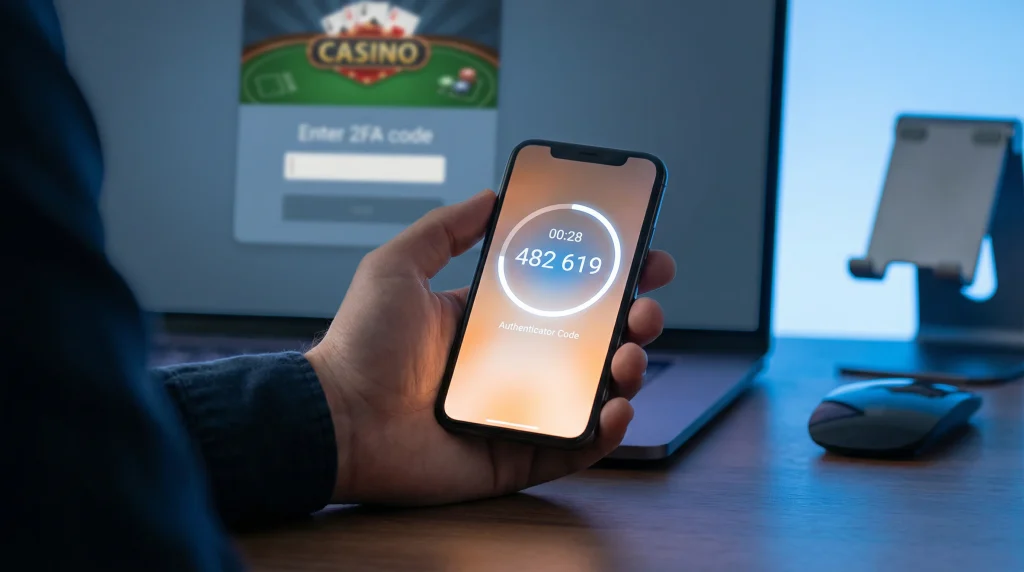
Navigate to your account’s security settings. Look for a section labelled “Two-Factor Authentication,” “2FA,” or “Security.” The casino will display a QR code and, beneath it, a text string — the secret key. Open your authenticator app and scan the QR code. The app registers the casino as a new account and begins generating six-digit codes that refresh every thirty seconds.
The casino will ask you to enter a current code from the app to confirm the link is working. Type the six digits displayed on your phone, submit, and 2FA is active. From this point forward, every login attempt requires both your password and a current code from the authenticator app. Some casinos also require the code for withdrawal requests, adding a second protection layer specifically for fund transfers.
Before closing the setup screen, record the secret key — the text string displayed alongside the QR code. This key is your recovery mechanism. If you lose your phone, factory reset it, or delete the authenticator app, the secret key allows you to re-register the casino in a new authenticator installation. Without it, you’re locked out of your own account, and a no-KYC casino’s support team has limited tools to verify your identity and restore access. Write the key on paper and store it with the same care you’d give a crypto wallet seed phrase — because functionally, it serves a similar purpose.
Not every no-KYC casino offers 2FA. Some smaller or newer platforms haven’t implemented it, leaving your account protected by nothing more than a password. If a casino you’re evaluating doesn’t support two-factor authentication, weigh that absence seriously. A platform that handles cryptocurrency deposits and withdrawals without offering basic account security is either technically negligent or indifferent to the risk its players carry. Neither reflects well on how it manages other operational responsibilities.
Authenticator Apps vs SMS — Why It Matters
SMS-based two-factor authentication sends a verification code to your phone number via text message. It’s better than no second factor at all, but it’s meaningfully weaker than app-based authentication — and for crypto casino accounts, where the stakes involve direct financial loss, the difference matters.
SIM swapping is the primary vulnerability. An attacker who convinces your mobile provider to transfer your phone number to a new SIM card receives all your incoming text messages, including 2FA codes. SIM swap attacks are well-documented, increasingly common, and particularly targeted at individuals known to hold cryptocurrency. The attack requires social engineering a customer service representative at the mobile provider — a lower barrier than most people assume. Once the number is transferred, every SMS-based 2FA code goes to the attacker’s device instead of yours.
SS7 protocol vulnerabilities represent a second attack vector. The signalling system that routes text messages between networks has known security flaws that allow technically sophisticated attackers to intercept SMS traffic without performing a SIM swap. These attacks are less common than SIM swapping and require more resources, but they’ve been documented in real-world incidents targeting cryptocurrency holders.
Authenticator apps — Google Authenticator, Authy, Microsoft Authenticator, or the open-source Aegis — generate codes locally on your device using the shared secret key. The codes never travel over a network. There’s nothing to intercept, nothing to reroute, and no mobile provider employee who can be socially engineered into handing over access. The code exists only on your phone and only for thirty seconds before a new one replaces it.
Authy deserves specific mention because it offers encrypted cloud backup of your authenticator accounts — a feature that Google Authenticator historically lacked. If you lose your phone, Authy lets you restore your 2FA accounts on a new device through your Authy account, protected by a separate password. This addresses the recovery problem without sacrificing the security advantages of app-based authentication. The trade-off is that a cloud backup introduces a remote attack surface that a purely local authenticator doesn’t have. For most users, the recovery benefit outweighs this marginal risk increase.
Additional Security Layers for Crypto Accounts
Two-factor authentication protects your casino login. But the security chain extends beyond the casino to your email account, your crypto wallet, and the device you use to access both. A compromise at any point in this chain can lead to fund loss, even with 2FA active on the casino itself.
Your email account is the recovery mechanism for most online services, including casino accounts. If an attacker gains access to your email, they can request password resets at the casino, potentially bypassing 2FA if the reset process doesn’t require a second factor. Enable 2FA on your email account with the same authenticator app you use for the casino. Use a strong, unique password that isn’t reused from any other service.
Password management is foundational. Every account — casino, email, crypto exchange, wallet — should have a unique password generated by a password manager. Reusing passwords across services means a breach at any one of them compromises all of them. Password managers like Bitwarden, 1Password, or KeePass generate and store complex passwords, and the only password you need to remember is the master password for the manager itself.
Device security covers the physical layer. A phone without a lock screen — or with a trivially guessable PIN — exposes your authenticator app, your wallet, and your casino sessions to anyone who handles the device. Use biometric authentication or a strong PIN. Keep your operating system and apps updated, because security patches address vulnerabilities that attackers actively exploit. Avoid installing apps from unknown sources, particularly on the same device where you manage crypto wallets and casino accounts.
Hardware wallets add a final layer for players holding significant cryptocurrency balances. A Ledger or Trezor device stores your private keys offline, making them inaccessible to malware, phishing attacks, or remote compromise. For the dedicated gambling wallet — the one you fund with amounts you’re prepared to play with — a software wallet with 2FA is adequate. For the primary wallet holding your savings, a hardware wallet removes the software attack surface entirely.
Two Steps Between You and Disaster
Two-factor authentication is the simplest, most effective security measure available to no-KYC casino players. It takes five minutes to set up, costs nothing, and transforms an account that anyone with your password can drain into one that requires physical access to your authenticator device. In an environment where account recovery options are limited and stolen funds are unrecoverable, those five minutes represent the highest-value investment of time you’ll make at any anonymous casino.
Enable 2FA on every casino account, every email account, and every crypto exchange or wallet that supports it. Use an authenticator app, not SMS. Store your backup codes and secret keys offline, in a physical location, separate from the devices they protect. And treat account security as a prerequisite for playing, not an afterthought. The games will still be there after you’ve locked the door.