
Casino No ID Verification UK: What Checks Still Apply
 Available in GB
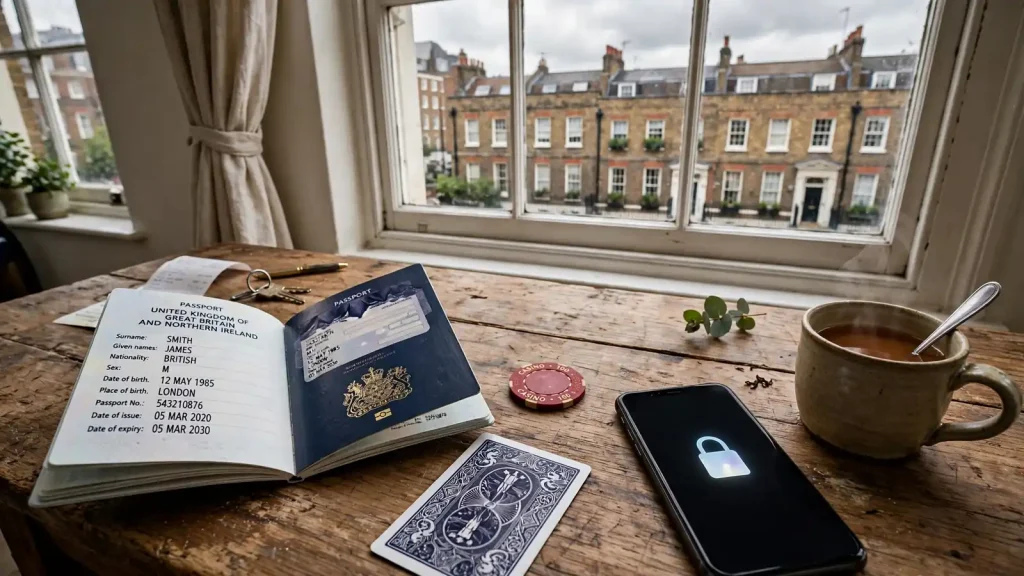
The label may describe sign-up timing, but age and identity checks remain part of online gambling in the UK.
What “No ID” Means at an Online Casino
“No ID” is a marketing label, not a reliable promise that an online casino will never check who you are. In Great Britain, online gambling businesses must verify your age and identity before you gamble. A site cannot turn that requirement into an optional extra by describing itself as a no-ID casino.
The wording often points to a perceived difference in the sign-up process: a player may be able to create an account without immediately being asked to upload documents. That is not the same as being exempt from identity checks. The key distinction is between when a check takes place and whether the operator must check your age and identity before gambling. The label can blur those two questions; the underlying requirement does not.
If you are looking for an online casino with no ID needed in the UK, read the claim narrowly. It may suggest that registration appears simple, but it does not establish that you can play real-money games without verification. Nor does “no photo ID” mean that age and identity checks disappear. It describes a sales pitch, not a separate set of rules for players.
Non-GamStop Curacao Casino Sites: UK Checks
The baseline before you play
For online gambling in Great Britain, the operator must establish that you meet the age requirement and confirm your identity before you gamble. This applies whether you plan to play slots or another kind of online casino game, and whether the site calls itself no-ID, no-KYC or something similar. The wording on a landing page cannot override the requirement.
That matters because “registration” and “permission to gamble” are not interchangeable. An account form might ask for basic details and let you continue through some account steps. Seeing that screen does not prove that the operator has completed the checks required before play. A smooth sign-up is not evidence that the site has waived verification.
The practical question is therefore not simply, “Does this casino ask for ID?” It is whether the operator verifies your age and identity before you are allowed to gamble. If a claim suggests that no checks of any kind are needed, treat it as a warning sign rather than as a special benefit. No wording can make gambling without the required checks compliant.
Casino Sites: UK Licensing and Access Guide
Online gambling in the UK is legal at licensed and regulated sites. That baseline is separate from the language a casino uses in its advertising: a “no ID” description does not itself tell you whether the operator is legally entitled to serve players in Great Britain. The label answers neither the regulatory question nor the verification question.
What the label can and cannot tell you
The phrase can be useful only if you treat it as a prompt to investigate, not as a guarantee. It may refer to how the site presents registration, or to a claim that checks are not immediate. It does not tell you that verification will never happen, that you can play before your age and identity are checked, or that real-money play is available without those checks.
This distinction is especially important when a page promises an online casino with no ID check in confident terms. The stronger the promise, the more carefully you should separate marketing language from what the operator actually requires. A vague phrase is not proof of a process, and a brief sign-up screen is not proof that checks have been completed.
The same applies to searches for the “best” no-ID casino. There is no meaningful winner on the criterion of avoiding a requirement that applies to online gambling businesses in Great Britain. A more useful comparison starts with a different question: what does the site mean by the claim, and does its actual process meet the required age-and-identity checks before you gamble? “Best” depends on your needs, but no-ID wording alone cannot settle that choice.
For a player, the safe interpretation is plain: no-ID usually describes a claim about the experience or timing, not permission to bypass identity verification. You should not assume that a lack of an immediate document request means you are cleared to play. Check what the operator requires before gambling, and do not treat “no ID required” as a promise that can erase the baseline.
The headline may sound simple. The rule is not.
Marketing Label
No ID / No KYC
UK Requirement
Age and identity verification before gambling
Regulatory Body
UK Gambling Commission
Self-Exclusion
GamStop (UK-licensed sites only)
How to Check a Casino’s Licence and GamStop Status
A “no-ID” label tells you little about the operator’s regulatory position. To compare sites, separate two questions: does the casino hold a UK Gambling Commission licence, and is it covered by GamStop? These are related, but they are not interchangeable. A site’s own description, the payment methods it accepts and its registration page do not establish either answer.
Check the licence against the operator
For a casino serving customers in Great Britain, the key distinction is whether the operator holds the relevant UK Gambling Commission licence. Remote gambling businesses selling into the British market are expected to be licensed by the Commission, wherever the business is based. A company’s overseas address does not, by itself, settle whether it has permission to serve British customers.
Look for the operator’s legal name and licence details on its website, then check the licence number against the UK Gambling Commission’s public register before depositing. Match the registered business to the casino you are considering; a licence belonging to a different company is not evidence that the site itself is covered. If you cannot establish a match, treat its UK regulatory status as unconfirmed rather than relying on a badge or a claim in promotional copy.
A UKGC-licensed casino belongs to the British regulatory system. An offshore casino operates under an overseas licence instead and does not hold a UK Gambling Commission licence. That distinction matters when you assess a site advertised as a no-ID casino: the marketing phrase does not tell you who supervises the operator, which rules apply to it, or whether British self-exclusion arrangements cover it.
Non-UK-Licensed Casinos: Licences and Risks
The licence is the criterion. A polished site is not a substitute.
What GamStop status tells you
GamStop is the national online self-exclusion scheme connected to UK-licensed operators. Those operators must integrate with it. If you have registered with GamStop, the scheme is intended to prevent access to gambling accounts with participating UK-licensed businesses for the chosen exclusion period.
Non-GamStop casinos are not connected to that system because they do not hold a UK Gambling Commission licence. They operate under overseas licences, and those regulators do not make them part of GamStop. So “not on GamStop” is not a separate UK licence category or an alternative form of British regulation. It describes a gap in coverage.
If you have self-excluded through GamStop, an offshore site is not a way to preserve that protection. The exclusion does not extend to an operator outside the scheme, and choosing such a site can undermine the boundary you put in place. If you need help maintaining that boundary, use support tools and services such as GamCare, BetBlocker or Gamban rather than treating a different licensing jurisdiction as a workaround.
How to compare the two statuses
| Check | UKGC-licensed casino | Offshore casino |
|---|---|---|
| Regulator | UK Gambling Commission | An overseas regulator |
| UKGC licence | Required for a legal operator serving the British market | Not held |
| GamStop connection | Must be integrated | No obligation to integrate |
| What “no ID” tells you | Nothing about whether it is in GamStop | Nothing about the quality or reach of its overseas licence |
The table compares regulatory status, not the quality of an individual casino. “Offshore” covers operators under different overseas licensing arrangements; the label alone does not establish that each licence is current or that its holder meets the same standards. Check the named regulator and operator details rather than assuming all Non UK registered casinos are alike.
What UK residents should take from the distinction
The legal position is not simply that every offshore site is inaccessible to a UK resident. UK residents can legally play at a casino licensed outside the UK where the operator is not illegally targeting the UK market. At the same time, remote operators offering gambling to customers in Great Britain must hold a UK Gambling Commission licence. Those points concern the operator’s conduct and status; they do not turn an overseas licence into a UK licence.
That distinction is useful when comparing no-ID casino sites. A claim that a casino accepts British players, or that it has an overseas licence, does not demonstrate that it is authorised to target the British market. Nor does the absence of a UKGC licence automatically mean that GamStop covers the site; it does not. Check the licence and GamStop status separately, and do not treat one as proof of the other.
UKGC-licensed casino
Must verify age and identity before you gamble and is integrated with GamStop.
Offshore casino
Operates under an overseas licence and has no obligation to integrate with GamStop.
If self-exclusion coverage is your priority, the practical comparison is straightforward: UKGC-licensed operators must participate in GamStop, while offshore operators have no such obligation. If you are assessing a site’s regulatory status, the deciding evidence is its operator and licence on the relevant public register—not the words “no ID”, “no KYC” or “no GamStop” in an advert.
When a Casino May Ask You to Verify Your Identity
The useful comparison is not whether a casino asks for identity checks, but when those checks appear in your playing journey. At UK-licensed sites, verification often takes place before your first deposit. At offshore sites, the process is commonly deferred until you request your first withdrawal. That difference can make the second option look like a no-ID casino, but it describes delayed checks, not their removal.
| Site type | Common point for verification |
|---|---|
| UK-licensed casino | Before the first deposit |
| Offshore casino | Before the first cashout |
These are typical patterns, not promises about every operator. A UK-licensed casino may ask for checks at another point, and a foreign-licensed site may request them earlier than expected. UKGC-licensed casinos almost always require verification at some stage.
The timing matters because a late request can interrupt a plan to cash out. If you have deposited and played before the casino asks for verification, you may find that a withdrawal cannot proceed until its checks are complete. Do not treat the ability to register, deposit or play as confirmation that all checks have been cleared.
At a UK-licensed site, an early check can feel like extra friction before play. Its practical advantage is that you are less likely to discover only at cashout that verification is still outstanding. With an offshore site that postpones checks, registration may appear simpler, but you should not assume that the first withdrawal will be immediate or unconditional.
A useful way to compare two casinos is to record the stage at which each says verification may happen: before depositing, before playing, or before a first withdrawal. Then compare that timing with your priority. If you want fewer interruptions later, earlier checks may be preferable. If quick sign-up is your priority, a site that delays checks may appear more convenient at first—but that convenience can shift the task to cashout. Different point of friction.
Do
- Check the operator’s legal name against the UKGC public register.
- Verify the timing of identity checks in the terms and conditions.
Don’t
- Assume a “no ID” label means you can bypass identity verification.
- Treat an offshore licence as a substitute for UK regulation.
Read the operator’s terms and account information for its stated verification triggers before committing funds. Look for whether checks are described as a condition of opening an account, depositing, gambling or withdrawing. Wording such as “no ID at registration” only tells you what happens at registration; it does not establish that you will never be asked to verify your identity.
For a UK player, “no ID verification” is therefore a poor basis for comparing casinos on its own. Compare the timing instead. A site that checks earlier may be more predictable at withdrawal; one that checks later may offer a smoother start but leave an unresolved step before your first cashout. The better fit depends on which stage you would rather deal with—not on a claim that checks do not apply.
What a No-ID Check Can Still Involve
“No ID” can describe a sign-up that does not ask you to upload documents straight away. It does not mean the operator has no way to check who you are. An offshore casino may use electronic identity checks, or eKYC, to compare the details you provide with other records automatically. A check can happen without a visible document-upload step.
If the automated result does not settle the question, you may be asked for evidence. Identity documents are only one possible part of that request. A specialist review of no-KYC casinos reports that checks may also cover your address, contact details or source of funds. Treat that as a possible scope, not a standard checklist every operator applies.
Online Casino No Registration UK: What It Means
The distinction matters when you read a casino’s claims. A site may describe registration as “no-KYC” while retaining the ability to request information to confirm your identity or assess your account. The label says little about which checks the operator can carry out. Fine print and account notices are more useful: look for what information may be requested, how to submit it and what happens if the details cannot be confirmed.
A request for address evidence, for instance, is not the same as an identity document; contact information may also need to match the account details. Source-of-funds questions concern where gambling money comes from, rather than simply who owns the account. Keep your registration information accurate, and do not assume that an automated check means no further evidence can be requested.
A shorter sign-up is not the same as a narrower check. The paperwork may still follow.
Our top casino picks for the UK
- ZombillionBonus: Welcome Pack 250% up to £4000 + 200 FS · Payout speed: 1-3 business days
- SlotoSportBonus: 500% up to £ 10 200+ 777 FS · Payout speed: 1-3 business days
- NightWinBonus: £900 + 400 free spins · Payout speed: 1-3 business days
- DieselwinBonus: Welcome Pack 250% up to £4000 + 200 FS · Payout speed: 1-3 business days
- SpinFormulaBonus: 550% Up To £15,000 + 550 FS · Payout speed: 1-3 business days
- NightLuckBonus: Welcome Pack + 805% Up To 6400€ + 280 FS · Payout speed: 1-3 business days
- JetsetspinsBonus: 200% Bonus + 100 Free Spins + Free Royal Wheel · Payout speed: 1-3 business days
- BritsinoBonus: Welcome Package – Get your £2,200 + 2,000 FS · Payout speed: 1-3 business days
Playing Slots Without Skipping Verification
A slot described as “no ID” is not permission to play for money without age and identity checks. For online gambling in Great Britain, the UK Gambling Commission requires the business to verify both before you gamble. The label cannot remove that requirement.
The useful comparison is not between slots that ask for ID and slots that do not. It is between real-money play, where the checks apply, and claims that suggest otherwise. If a casino advertises slots as needing no verification, treat that wording as a description of its sign-up experience at most—not proof that you can gamble without being checked.
Whether you are playing traditional slots or video slots, playing with real money always requires age and identity verification under UK law.
Real-money play is the dividing line
A slot’s theme, format or provider does not change the requirement. Whether you choose a familiar fruit machine-style game or a more elaborate video slot, playing with real money is still online gambling. The same age-and-identity rule applies across the catalogue.
That matters when you see terms such as “no ID needed” attached to a casino’s slot lobby. The wording may make the route to a game sound simple, but it does not establish that the operator can let you start real-money play without verifying you. A claim about fewer steps is not an exemption from the rule.
| What you are comparing | What the label tells you |
|---|---|
| A real-money slot | It is gambling, so the required age and identity checks still apply before play. |
| A casino calling its slots “no ID” | The phrase does not cancel those checks or guarantee access without verification. |
| A free-play version | It is not the same as placing real-money bets; do not treat a free-play label as evidence that real-money checks have been waived. |
The key criterion is whether you are gambling for money, not whether the game is called a slot, a fruit machine or a free-play game. Simple distinction.
Read “no ID” as a claim, not a rule
A casino may present no-ID wording prominently, but the wording itself does not tell you whether a real-money game can be played lawfully without the required checks. It cannot. For a UK player, the relevant standard is that age and identity must be verified before gambling begins.
So if you are comparing sites on how quickly you can reach a slot, do not rank one as better merely because its page promises no ID. That criterion measures marketing language, not whether the site can dispense with verification. The meaningful question is whether the advertised route to real-money play still involves the required checks before you gamble.
This is also why “slots with no verification” and “slots you can play for real money without proving your identity” are not interchangeable descriptions. The first may be a label used by a casino; the second describes an outcome that conflicts with the requirement for online gambling businesses in Great Britain.
Anjouan Casino Licence in the UK: What It Means
Free play is not a workaround
Some pages combine no-ID wording with free slots or play without a deposit. Keep the categories separate. A free-play game is not a real-money slot session, while a real-money game remains subject to age and identity verification. A free-play option therefore does not show that the same casino can lawfully waive checks when you switch to gambling for money.
Nor should you assume that a game can be played for money simply because it opens without a visible document request at that moment. The rule concerns verification before gambling, not whether a particular screen displays a request. If the operator has not verified the required details, the “no ID” description does not make real-money play exempt.
A practical way to assess the claim
When you encounter a no-ID slot claim, use a simple test:
- Is the game being offered for real money, or only for free play?
- Does the wording imply that age and identity checks are unnecessary?
- Is the claim describing a lower-friction sign-up, rather than the conditions for gambling?
For real-money slots, the answer to the second question should make you cautious: checks cannot be skipped. The label does not change that, whatever game appears behind it. If the claim suggests otherwise, do not treat it as a reliable description of what is required to play.
The practical comparison is therefore straightforward. A genuine free-play mode is distinct from gambling for money; a real-money slot remains subject to verification before you gamble. “No ID needed” may sound like a feature, but it cannot turn that requirement off.
Real-Money Games and Crypto Do Not Remove Checks
A casino may accept Bitcoin or Ethereum and still require you to prove who you are. The payment method and the operator’s identity checks are separate things: using cryptocurrency does not establish your age or identity, or cancel the operator’s obligations.
For real-money online gambling in Great Britain, the key requirement is that the operator holds a UK Gambling Commission licence and verifies your age and identity before you gamble. That applies whether you choose a table game, a slot or another casino game, and whether you deposit using a bank card, an e-wallet or crypto. A site’s claim that games are available without ID does not change that baseline.
Important Distinction
Cryptocurrency is a payment method and does not replace the legal requirement for identity verification.
What the crypto label tells you — and what it does not
A crypto option tells you something about how the casino accepts payments. It does not, by itself, tell you which regulator licences the operator, whether the operator is authorised to serve the British market, or what checks it will conduct. Treat those as separate criteria when comparing sites.
An offshore operator may advertise registration without immediate document requests, including for customers who use crypto. That is not proof that checks have been waived. Offshore sites commonly conduct identity checks before processing a first withdrawal, and some use electronic checks automatically. Crypto is not a substitute for verification.
The distinction matters when you are deciding whether to play for real money. A game that loads without asking for documents is not evidence that the operator has confirmed your age and identity. Nor does paying in crypto make an unlicensed site a licensed one. Remote gambling operators serving the British market are required to hold the relevant UKGC licence; a different payment method does not alter that rule.
A useful comparison is therefore not simply “crypto accepted” versus “crypto unavailable”. Look at the operator’s regulatory status and its stated verification process independently. If the site presents crypto as a way to play anonymously or avoid identity checks, that claim should not be treated as a reliable description of what will happen when you use the service.
Non-GamStop European Casinos: UK Exclusion Explained
For you, the practical test is straightforward: distinguish a payment feature from permission to gamble. Crypto can change how money moves between you and an operator. It cannot establish that you meet the age requirement, confirm your identity on the operator’s behalf, or remove the operator’s verification duties. Different function. Same checks.
No-Deposit Bonuses, Crypto Deposits and the Fine Print
A no-deposit bonus can sound like a way to try a casino without putting money in first. When it is paired with a “no-ID” claim, though, neither phrase should be read as a promise that an offer is available, unconditional or free of checks. Treat the bonus and the casino’s identity process as separate matters.
Before accepting an offer, read its terms rather than relying on the headline. Check who can claim it, which games count, whether winnings are restricted, and what conditions apply before you can withdraw. A bonus may be limited to particular customers or payment methods, and an offer described as no-deposit may still come with requirements. If those terms are unclear, the advertised value tells you little.
Attention
Offshore casino credit-card deposits can carry reported fees of 2% to 5%.
The same caution applies when a promotion mentions crypto. Bitcoin or another cryptocurrency is a way to fund an account where accepted; it does not make a bonus automatically eligible or remove its conditions. Look for any payment-method exclusions in the promotion rules before depositing. A crypto label is not a shortcut through the fine print.
Payment choice can also affect the cost of a deposit. UK-licensed casinos cannot accept credit-card gambling deposits, while offshore platforms may accept Visa or Mastercard. A specialist review reports that offshore casino credit-card deposits can carry fees of 2% to 5%. That is a reported charge, not a fixed tariff: check the casino’s payment terms and your card provider’s information before proceeding. A fee can make a supposedly low-cost bonus less attractive.
Compare offers by the terms that matter to you: whether a deposit is required, which payment methods qualify, and what must happen before any winnings can be withdrawn. The better offer depends on your priority, not on the largest figure in a banner. If a bonus requires a deposit by a method you would not otherwise use, or its conditions are difficult to understand, declining it may be the clearer choice.
“No deposit” describes the advertised entry point, not the whole deal. “No ID” should not be treated as a guarantee that the casino will never request verification. Keep those claims separate from the practical question of whether the promotion’s conditions suit you. Read first. Then decide.
Why “No-ID Withdrawal” Does Not Guarantee an Instant Payout
A casino’s “no-ID withdrawal” label is not a promise that you can cash out without checks. At offshore casinos, identity verification is typically required before the first withdrawal is processed. Many non-GamStop casinos also ask for identity documents before approving a payout, even if their marketing uses “no-KYC” language. The useful comparison is not which site claims the fewest checks, but whether its published withdrawal terms explain what can hold up approval.
A payout has two separate stages:
- Casino approval: the operator reviews the withdrawal request and may ask you to complete identity checks before releasing it.
- Payment settlement: once approved, the payment still has to be processed through the chosen method.
That distinction matters. A request can be waiting for the casino even though no payment has been sent; alternatively, the casino may have approved it while settlement is still pending. “Withdrawal requested” and “money received” are not the same status.
Read the withdrawal terms, not just the label
Before depositing, look for the operator’s rules on verification and withdrawals. Check whether the casino reserves the right to request identity documents before approval, and whether the terms explain what happens to a request while checks are outstanding. A no-KYC claim on a landing page cannot override the withdrawal conditions in the casino’s own rules.
This is particularly relevant if you are comparing sites promoted as no-ID casinos for real-money play. The better choice for a player prioritising predictable cash-out is the operator with clear, accessible conditions—not the one making the broadest claim. If the terms are vague about verification or how a pending request is handled, you have less clarity before committing funds. No shortcut is implied.
Does “no ID” mean I won’t be asked for documents?
No. It often just means documents aren’t requested during the initial sign-up, but they may be required before gambling or withdrawing.
Can I use Boku to withdraw my winnings?
No. Boku and similar mobile-payment methods are typically deposit-only at offshore platforms.
Is a no-deposit bonus always free of checks?
No. Even with a no-deposit bonus, the operator may still require identity verification according to their terms.
Limits can stretch access to a large win
Approval does not necessarily mean the full balance will arrive at once. A specialist review reports that some offshore casinos set monthly withdrawal caps, which can delay access to a large win. Treat that as a condition to check for each operator, not as a universal rule: limits differ, and the relevant figure should be stated in the casino’s own withdrawal terms.
Look for daily, weekly or monthly limits and check whether they apply to each payment method or to withdrawals overall. Also note whether the terms explain how a request is handled when the amount exceeds a cap. A large balance may therefore involve more than one payout, even if the casino has approved the withdrawal. The cap affects access to funds; it does not, by itself, show that an identity check has been completed or that payment settlement has begun.
For a practical comparison, record three things for each casino: the point at which documents may be requested, the withdrawal limits, and the status information provided after approval. That makes the difference between a site with a credible process and one with an attractive label easier to see. If you cannot establish those conditions from the operator’s terms, “instant” is only a word.
Free Spins Still Come With Verification Questions
A free-spin offer may look like a way to try slots without supplying details, but the promotion does not suspend the rules for real-money gambling. In Great Britain, an online gambling business must verify your age and identity before you gamble. A banner describing free spins as “no ID” is not an exemption.
The useful comparison is between the offer’s headline and its actual terms. Check whether the spins are available to new or existing customers, which games they apply to, and what conditions attach to any winnings. The terms should also explain what information the casino requires before you can use the promotion. If they are unclear, the headline tells you little.
Non-UK Regulated Casinos: Licences and UK Rules
“Free” describes the promotional spins, not necessarily the whole experience. Conditions may affect eligibility or the ability to withdraw winnings, so read the promotion rules before opting in. Do not assume that a no-deposit label means no registration, no checks or unrestricted access to winnings.
For a UK player, the deciding criterion is not whether an offer promises no-ID free spins; it is whether the operator can verify you before you gamble and states the promotion conditions plainly. If the offer implies that you can play real-money slots in Great Britain without age and identity checks, treat that claim with caution. A promotional label cannot override the requirement.
Free spins may still be attractive when the terms suit you. But the label is not a shortcut through verification.
Pay by Mobile: Deposits Are Not Withdrawals
Boku may appear among the payment options at an offshore casino, but its role is limited. A specialist review describes Boku and similar mobile-payment methods as deposit-only at offshore platforms. That means they can be used to put money into an account, but they are not a route for receiving a payout.
Keep the two directions separate when comparing payment methods. A casino may accept a mobile payment for deposits without offering the same method for withdrawals. If you choose to pay this way, check the operator’s payment terms and identify which withdrawal methods are available before you fund the account. Otherwise, you could deposit using one method and need another to cash out.
The “no ID” label does not alter that distinction. It describes a claim about verification, not what a payment method can do. Boku should not be treated as a way to withdraw winnings or as evidence that a casino will not ask for information. Payment function and identity checks are separate matters.
A simple comparison helps: Boku is a deposit option in the cited description; it is not a withdrawal option. If your priority is paying by mobile, that may suit the deposit side of the transaction. If you need the same method to return funds, it does not meet that need. Check the cashier’s stated options rather than assuming that an available deposit method works both ways.
Convenient in one direction.
Is it actually possible to get free spins with no deposit and no ID verification in the UK in 2026?
No, you must have your age and identity verified before gambling in Great Britain, including with free spins. A casino’s “no ID” claim does not remove that requirement.
Do UK banks block deposits to non-GamStop casinos?
Yes, UK banks may decline, flag, delay or block payments to offshore gambling sites. Some banks block these transactions by default.
Can I use GamStop while playing at non-UK-registered casinos?
No, GamStop does not cover offshore casinos that are not connected to the scheme. UK-licensed operators must integrate with GamStop, while offshore casinos have no such obligation.
Can my bank block deposits to non-UK-licensed casino sites?
Yes, your bank may decline, flag, delay or block payments to offshore gambling operators. Some UK banks block these transactions by default.
What is the difference between a non-UK-licensed casino and a UKGC-licensed casino?
A UKGC-licensed casino is regulated by the UK Gambling Commission and must be part of GamStop. A non-UK-licensed casino operates under an overseas licence and is not required to join GamStop; checks may also happen later, often before a withdrawal.