
Casinos That Accept E-Cheques in the UK: What to Check
 Available in GB
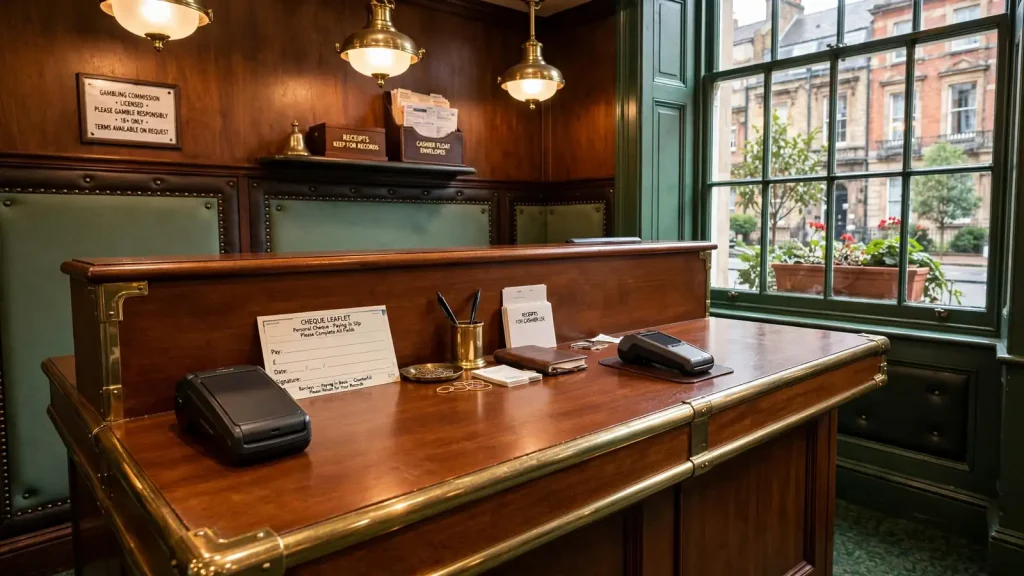
Availability can vary by account and payment product, while payout rules, timing, limits and costs may differ from deposits.
Check the Cashier Before Assuming a Payment Method Is Available
A casino’s payment page can make a method look supported without confirming that you can use it to make a deposit now. For e-cheques, treat any general claim about acceptance as a prompt to check the individual casino’s cashier, not as confirmation that the option is available to every UK customer.
The distinction matters because a payment method may be described on a site yet be absent from the live cashier, unavailable in your account, or restricted for a particular payment product. A listed logo is not the same as an enabled option at the point you pay. The cashier is where you can check what the casino currently offers for your account.
What a payment-method claim does—and does not—tell you
A specialist review may list payment methods found on the casino websites it examined. That can help you identify what to investigate, but it does not establish that an option remains active or is available to you. Payment pages can change, and access may depend on the casino’s current arrangements and the details of your account or payment product.
This is relevant to e-cheques, but it is not unique to them. A site may mention bank transfer, e-wallets or other payment types without showing that every customer can select each one. Likewise, a casino’s general page may name Visa or Mastercard while the cashier applies conditions to the card product you intend to use. A method name is a starting point, not a green light.
Casinos That Accept Tether in the UK: What to Check
For a search such as “casinos that accept e-cheque in the UK”, the useful test is therefore practical: open the casino’s own cashier and see whether e-cheque appears as an available deposit choice for your account. If it is not shown there, a general description elsewhere is not enough to assume you can use it.
Check the live cashier, not just a list
Before relying on a casino’s payment information, sign in and inspect its deposit options. Look for the method by its displayed name and read any conditions attached to it. If the cashier does not show e-cheque, or the wording leaves you unsure whether it applies to your account, ask the operator to clarify before attempting a payment.
You can use the same check for card payments. The payment methods listed on casino sites include Visa and Mastercard, but current UK availability and eligibility depend on the cashier and the card product. Seeing a card brand on a general payments page does not prove that your particular card can be used. UK-licensed casinos cannot accept credit-card payments for gambling, so a card listing should never be read as permission to use a credit card.
Casinos that accept USDC in the UK: how to check
That is a practical distinction, not fine print for its own sake. The displayed method, the payment instrument you hold and the rules attached to your casino account all need to match. If one does not, the option may not be available for your transaction.
A quick availability check
Use a short checklist before treating any e-cheque claim as current:
- Open the casino cashier. Check the deposit options shown after signing in rather than relying only on a general payment page or third-party list.
- Confirm the exact method. Make sure the option is e-cheque, not a different bank or card service with similar wording.
- Read account-specific conditions. Check whether the option is presented for your account and whether the cashier displays any restriction.
- Check the payment product. For a card, confirm the specific card is eligible; a brand name alone does not establish that.
- Ask the operator if it remains unclear. A written response from customer support is more useful than guessing from a logo or an old listing.
A casino accepting one payment route does not imply that it accepts every route, and a method mentioned in a review does not establish that it is currently selectable. The cashier settles the question for the account you are using.
How to judge “best” without a confirmed list
Calling a site one of the best e-cheque casinos only makes sense after you have confirmed that e-cheque is actually available in its cashier. Otherwise, the comparison rests on a feature you may not be able to use. Start by separating confirmed availability from general payment information; only then can you assess whether a casino suits your needs.
This also keeps the decision grounded in what you can verify. If e-cheque does not appear, do not infer support from a broad statement that the casino accepts online payments or from the presence of other banking methods. If it does appear, read the conditions shown before proceeding. Availability is specific, not implied.
A clear listing may help you decide where to look, but the live cashier is the point to confirm. No guesswork needed.
The same approach applies whether you are looking for UK casinos accepting e-cheque deposits or comparing sites that mention the method. A clear listing may help you decide where to look, but the live cashier is the point to confirm. No guesswork needed.
Our top casino picks for the UK
- ZombillionBonus: Welcome Pack 250% up to £4000 + 200 FS · Payout speed: 1-3 business days
- SlotoSportBonus: 500% up to £ 10 200+ 777 FS · Payout speed: 1-3 business days
- NightWinBonus: £900 + 400 free spins · Payout speed: 1-3 business days
- DieselwinBonus: Welcome Pack 250% up to £4000 + 200 FS · Payout speed: 1-3 business days
- SpinFormulaBonus: 550% Up To £15,000 + 550 FS · Payout speed: 1-3 business days
- NightLuckBonus: Welcome Pack + 805% Up To 6400€ + 280 FS · Payout speed: 1-3 business days
- JetsetspinsBonus: 200% Bonus + 100 Free Spins + Free Royal Wheel · Payout speed: 1-3 business days
- BritsinoBonus: Welcome Package – Get your £2,200 + 2,000 FS · Payout speed: 1-3 business days
How to Compare Payment Routes for Online Casino Banking
A payment route is not a single feature. To compare options for an e-cheque online casino in the UK, separate the decision into three stages: getting money into the account, receiving money back, and understanding the cost of each transaction. A method that appears straightforward at one stage may be less practical at another.
Start with the cashier’s description of the method. Check whether it is offered for deposits, withdrawals, or both, and note any conditions attached to each direction. Do not treat a payment logo or a general banking page as proof that the route works for your account. The relevant details are the ones shown for your account when you are ready to transact.
| Comparison point | What to establish |
|---|---|
| Deposit support | Can this route be used to fund the casino account? |
| Withdrawal support | Can a payout be sent through the same route? |
| Timing | How long may the deposit and payout stages each take? |
| Charges | Could the casino, provider, bank, issuer, or network charge for the transaction? |
| Account fit | Does the route use an account held in your name? |
Keep deposit and withdrawal timing separate. A deposit may be credited on a different schedule from a payout, so a single label such as “fast” can conceal the part that matters to you. Look for separate estimates for each direction, and check whether the stated payout timing begins when you request the withdrawal or after the casino has approved it. Those are different points in the process.
Avoid ranking routes by a promise of speed alone. The useful comparison is how well each route fits your own priority: a quick deposit, a clear payout path, fewer possible charges, or a straightforward account match. The winner depends on the criterion. A route that suits one priority may not suit another.
Compare the full transaction, not the payment label
The name of a method tells you little about its total cost. A payment can involve charges from more than one party: the casino, the payment provider, a bank or card issuer, or a payment network. If a currency exchange takes place, the exchange-rate spread may also affect the amount that reaches or leaves your account. A specialist payment review identifies these as possible cost points; the exact combination depends on the transaction.
Check the casino’s terms and the payment provider’s own terms, rather than assuming that a displayed fee is the only one. A visible flat charge is easy to spot; a less obvious exchange-rate difference may also affect the final value. Compare the amount you expect to pay with the amount that will actually be credited, and the amount you expect to receive with what arrives. If a cost is unclear, ask the relevant provider or the casino before proceeding.
This is particularly useful when comparing an e-cheque route with a bank transfer, card, or e-wallet. The method names do not establish which one costs less. The answer can depend on the casino’s charges, the provider’s terms, and the details of your transaction. There is no useful “cheapest” label without those details.
Casinos that accept EntroPay in the UK: what to check
Use a consistent comparison sheet
Write down the same information for each route you are considering. Record whether it is available for deposits and withdrawals, the timing given for each stage, any stated fees, and whether currency conversion could apply. Add the source of each detail, such as the cashier, the casino’s terms, or the provider’s fee schedule. That makes it easier to distinguish a clear condition from a broad description.
Also note whether the payment route is tied to an account in your name. Using one named account consistently for deposits and withdrawals can make the transaction path easier to follow. It is a practical comparison point, not a promise that every route will be accepted for every purpose.
For an e-cheque casino site in the UK, apply the same test as you would to any other payment option. Do not infer that a method is suitable merely because it is mentioned in a general description. Compare the available deposit and payout functions, the timing attached to each, and the possible costs for your transaction. Then choose according to the feature you value most, rather than treating a single headline as a complete banking assessment.
A compact table is more useful than a string of payment logos. If a casino gives no clear answer about one of the stages, leave that comparison point unresolved instead of filling it with an assumption. That is not indecision; it is an honest record of what the route can tell you.
Choose by Withdrawal Speed, Not Just Deposit Speed
A deposit confirmation tells you that money has reached the casino balance. It does not tell you when a withdrawal will arrive in your bank account. Treat those as separate timings: one measures money going in, while the other includes the casino’s decision to release a payout and the time it takes to reach you.
Casinos that accept bank cheques in the UK
That distinction matters when comparing casinos associated with e-cheque payments. A payment route may be presented as quick for deposits, but that alone does not establish that withdrawals are available through it or how long they take. Check the casino’s published withdrawal information, not just the deposit description, and compare the expected payout time rather than letting a fast cashier confirmation decide the ranking.
Separate the stages of a withdrawal
A payout can involve more than the transfer itself. The casino may first review and approve the request; only after release does the payment move through the relevant processing route. The total wait therefore depends both on the operator’s internal approval and on the time after approval. A headline that describes only one stage is not a reliable estimate of when funds will be in your account.
A specialist review reports that a card deposit can be instant while a payout takes several business days. That comparison is a useful warning about the gap between paying in and receiving money, not a timetable that applies to every casino or card. Look for the casino’s own current terms, and check whether its stated estimate begins when you request a withdrawal or when it approves one.
| Timing point | What it tells you | What it does not tell you |
|---|---|---|
| Deposit confirmation | When the payment appears in your casino balance | When a later withdrawal will be approved |
| Casino approval | When the operator authorises the payout | When the receiving account will show the funds |
| Arrival estimate | The expected time for funds to reach you | Whether additional review could affect the request |
This is the useful comparison: not “instant versus slow” as a general label, but which part of the journey the label describes. A quick deposit can be convenient for starting play and still be a poor fit if access to withdrawn funds is your priority. The winner depends on what you need.
First withdrawals can take longer
Withdrawal processing may extend when a casino is completing verification, and first payouts can take longer while those checks are finished. This makes the first withdrawal a poor test of a payment route’s normal delivery speed: some of the wait may be the casino reviewing the account rather than the payment provider moving funds.
Before relying on a published estimate, check whether it assumes that the account is already verified and whether the casino gives a separate estimate for its approval stage. If those details are not clear, do not read a short transfer estimate as a promise about the full time from request to receipt. The clock may not start where you think it does.
Keep an eye on the status shown in your account after submitting a request. A payout still marked as pending has not necessarily reached the external payment stage. If the casino shows it as processed, that still may not mean the funds have appeared in your bank account. These status labels describe different points in the journey, so compare like with like when assessing a casino’s stated timing.
How to judge speed fairly
Use the same questions for each option you are considering:
- Is the published time for the casino’s approval, the transfer after approval, or the whole withdrawal?
- Does the estimate distinguish a first withdrawal from later requests?
- Does it assume that verification is complete?
- Is the estimate about processing, or actual arrival in your account?
If a casino only highlights deposit speed, treat that as an incomplete picture of banking convenience. For someone who values quick access to a payout, the withdrawal estimate and the conditions behind it carry more weight than the time taken to fund the balance. For someone focused on depositing, the priorities may differ. There is no universal winner.
For e-cheque payments specifically, do not infer withdrawal speed from the name of the deposit method. The payment label alone cannot establish how a payout is handled. Compare the casino’s stated withdrawal route and timing separately, and distinguish any operator review from the later transfer. If the cashier or terms do not explain the payout process clearly, the speed comparison is unfinished.
A practical choice is the casino whose withdrawal information lets you see what happens between request and arrival, with the account checks stated plainly. That is more useful than a deposit badge that says little about getting money back. Fast in is only half the journey.
Deposit Limits and Financial Controls to Check First
A deposit limit is not one fixed figure attached to a casino. The minimum and maximum can depend on the payment route you select and the status of your account. That matters if you are considering an e-cheque: do not assume that an amount accepted for another method will also be accepted for an e-cheque, or that a payment option’s presence means it has the same limits for every customer.
A specialist review puts some casinos’ minimum deposits in the £10–£20 range, but that is a reported range, not a rule for every operator or payment method. Check the amount displayed in the cashier for the specific route you intend to use. If e-cheque appears there, read the minimum and maximum shown beside it before entering a deposit. If it does not appear, there is no basis for treating it as an available route at that casino.
Casinos That Accept Ethereum in the UK
Check the limit that applies to your transaction
Maximum deposits may be set per transaction, per day or per month. Which cap applies can vary by payment method and account status, so one figure on a general information page may not answer the practical question. Look for the limits in the cashier and in your account settings; distinguish the amount allowed for a single payment from any broader account-level ceiling.
Account status can matter too. A limit visible before you have completed account checks may not be the only condition affecting what you can deposit. Treat the amount presented for your account as the relevant one, rather than relying on a general claim about what a particular payment type allows. If the limit is unclear, ask the casino before sending money.
For a fair comparison, note the amount you plan to deposit, the cashier’s minimum and maximum for that method, and any account-level restriction that applies. This is a more useful check than labelling one payment route “best”: the suitable option is the one whose permitted range fits your planned spending without encouraging you to exceed it.
Set a boundary before depositing
UKGC rules require remote gambling operators to prompt new customers to set a financial limit before their first deposit. They must also make account-level limit controls accessible. These are practical controls, not decorative settings: use them to decide in advance what you are comfortable spending, then keep the boundary in place rather than adjusting it impulsively during play.
DO
- Review the available controls in your account before making a deposit.
- Choose an amount that reflects your own budget.
- Set a boundary to manage your gambling spend.
DON’T
- Adjust your limit impulsively during play.
- Confuse a payment method’s maximum deposit with a sensible personal limit.
Review the available controls in your account before making a deposit. Check what kind of limit you are setting and the period it covers, then choose an amount that reflects your own budget. Do not confuse a payment method’s maximum deposit with a sensible personal limit. The first is a transaction or operator restriction; the second is a boundary you set to manage your gambling spend.
If an e-cheque cashier limit is higher than the amount you intend to spend, that does not make the higher amount a target. Likewise, a low minimum does not make a deposit affordable by itself. Your account limit should guide your decision, while the cashier’s figures tell you whether the transaction is permitted.
A short pre-deposit check
Before confirming a payment, verify that the cashier shows the chosen method, check its minimum and maximum, and review any daily or monthly cap that applies to your account. Then confirm that your financial limit is set and accessible. If the payment screen or account settings do not make the relevant restriction clear, pause and contact the operator rather than guessing.
The useful comparison is not which casino permits the largest deposit. It is whether the displayed limits fit your planned amount and whether your own control is set before you proceed. A higher cap is not an advantage when it makes overspending easier. Keep the boundary clear.
Keep Deposit and Withdrawal Details Consistent
When you assess an e-cheque casino in the UK, treat ownership consistency as a separate check from whether the cashier displays a payment option. The relevant question here is whether the casino account and the payment route are both in your name. Matching details can reduce avoidable questions about who owns the accounts involved in a transaction.
A simple comparison helps:
| Check | Consistent details | Details that may need explanation |
|---|---|---|
| Casino account | Registered to you | Registered to another person |
| Payment route | Belongs to you | Belongs to someone else |
The cleaner arrangement is one customer using their own casino account and the same named payment account consistently. That does not promise that a transaction will be accepted or processed without review; it simply avoids an obvious mismatch in basic ownership information.
Shared finances can make this less straightforward. A household account, a partner’s payment account or a business account may not show the same name as your casino profile. Before using one, check the casino’s terms and ask customer support how it treats that arrangement. Do not assume that permission to access an account makes you its recognised owner for payment purposes.
Consistency also means avoiding unnecessary changes between payment accounts. If you use one account for a transaction and introduce another later, the casino may need to establish how the accounts relate to you. Keeping a single route where practical can make the ownership picture easier to follow. Less ambiguity, fewer questions.
This is not a reason to force a particular payment method into your plans. Your preferred route may not suit your account, and a method’s appearance in a cashier does not settle every condition attached to its use. Compare the name on your casino profile with the name associated with the account you intend to use, then check the operator’s stated requirements before proceeding.
For the search for the best e-cheque online casinos in the UK, a useful ownership criterion is therefore straightforward: favour a setup in which the account holder and the payment-account holder are the same person, and in which you can use that named account consistently. That is a practical way to reduce avoidable friction, not a ranking of casinos or a guarantee of a particular outcome.
Casinos That Accept MuchBetter in the UK
Keep records of which account you use and ensure your registered details are accurate. If a legitimate difference in names or account ownership applies, resolve it with the casino before making a transaction rather than relying on an assumption.
Check Whether the Same Method Works for Payouts
A payment option shown beside the deposit button is not automatically a complete banking route. Before treating an e-cheque as suitable, check whether the casino also permits withdrawals through it. A deposit-only route may let you fund an account but leave the payout dependent on another method or process.
This matters because UK anti-money laundering rules commonly require casino payouts to go back to the original payment source. The cashier or payment terms should explain how that works for the method you are considering. Look specifically for whether e-cheque withdrawals are supported, whether they are subject to conditions, and what happens if the original route cannot receive a payout.
A casino may offer more than one way to deposit without offering the same choice for cashing out. So a page that mentions e-cheques, or a list describing a casino as an e-cheque option, does not by itself establish that the method works in both directions. The practical comparison is:
| What to confirm | Why it matters |
|---|---|
| E-cheque is available for deposits | Confirms you can use it to fund the account |
| E-cheque is available for withdrawals | Confirms it is not deposit-only |
| The payout can return to the original source | Shows how the casino applies its payment rules |
| An alternative route is explained | Helps you understand what may happen if return to source is not possible |
If the casino cannot return funds through the original method, it may allow another route, but that alternative can require additional verification. That is different from simply choosing whichever payout option looks easiest: the operator may need to establish that the new route is suitable before releasing funds.
For a useful e-cheque casino list in the UK, treat payout support as a separate criterion for every entry. A deposit label alone is not enough to compare options fairly. Check the cashier while logged in, then read the payment terms for any restriction on returning funds. If the withdrawal instructions are unclear, ask customer support to confirm the process before depositing.
The best choice depends on whether you value using e-cheque for deposits, having a defined route for withdrawals, or both. Do not count a casino as a full e-cheque option until the payout side is clear. One-way banking is a partial answer.
Banking Check
Do not count a casino as a full e-cheque option until the payout side is clear.
Payment Costs Depend on the Transaction
The cost of an e-cheque casino payment in the UK cannot be judged from a casino’s cashier label alone. A transaction may involve a charge from the casino, the payment provider, your bank or card issuer, or a payment network. If money is converted between currencies, the exchange-rate spread can add another cost even when no separate conversion fee is shown.
A specialist review notes that the exchange-rate spread can outweigh a visible flat charge. That is why comparing only the fee displayed beside a payment method can give you the wrong result. Check the terms for the specific route and consider the amount you intend to move: a fixed charge and a percentage-based cost affect transactions differently.
A useful comparison table keeps the components separate:
| Cost to check | Where it may appear |
|---|---|
| Casino charge | Cashier terms or payment conditions |
| Provider fee | The payment service’s pricing |
| Bank or issuer fee | Your account or card terms |
| Currency spread | The rate used for conversion |
| Network cost | The relevant payment network |
Do not assume a method has no cost because the casino advertises free deposits. That statement may cover only the casino’s own charge, not fees imposed elsewhere in the payment chain. Equally, a listed fee does not tell you the full cost if conversion or network charges also apply.
There is no universal lowest-fee method. A specialist review’s comparison supports checking casino charges, provider fees, currency spread and network costs against the actual transaction, rather than naming one method as cheapest for everyone. The result depends on the route, the amount and the terms that apply to your account.
For a fair comparison, record each possible charge before confirming a payment. If a fee or exchange rate is unclear, ask the casino or provider to explain it first. A small-print surprise is still a cost.
Confirm Currency Before Making a Deposit
Before making a deposit, check the currency shown for your casino account. A specialist review says GBP is supported, but that does not establish the currency of every account or transaction. Confirm the setting in your account or cashier before sending money, rather than assuming that a UK-facing site will automatically handle the deposit in pounds.
This matters whether you are considering an e-cheque or another payment route: the method and the currency are separate details. A payment option may be presented in the cashier while the casino account is set to a different currency. If those do not match, a conversion may occur somewhere in the transaction. Checking first can help you avoid a conversion you did not intend.
Look for the account currency in the cashier or account settings, and read the confirmation screen before authorising a payment. If the currency is unclear, ask the casino’s customer support to confirm what will be credited to your balance. Do not infer the transaction currency from a payment method’s name, a UK flag, or prices displayed elsewhere on the site.
Casinos That Accept Neteller in the UK: What to Check
Keep the distinction clear: the currency shown for your balance is not necessarily proof of the currency your bank or payment provider will use. Check the payment details presented at the point of authorisation as well. If the casino account is in pounds and the transaction is also processed in pounds, that avoids a mismatch at the casino end; your bank or provider may still apply its own conversion if your funding account uses another currency.
Treat currency as a compatibility check before depositing, not as evidence that a particular payment route is available. Confirm the account setting, inspect the final payment details, and proceed only when both are clear. Small check, fewer surprises.
Understand Why a Withdrawal May Need Extra Checks
A payout can be checked more closely than a deposit because the casino must establish where the funds should go and whether the request is legitimate. Returning money to the original payment source is a common anti-fraud and anti-money-laundering safeguard. It helps connect the withdrawal to the account and payment route used to fund it.
Casinos That Accept Interac in the UK: What to Check
If you ask for payment through a different route, the casino may need additional evidence before approving the transfer. That does not automatically mean there is a problem; it means the alternative needs to be checked against the account and transaction. An e-cheque mention on a casino page, for instance, does not by itself establish how withdrawals are handled. Confirm the relevant payout procedure with the operator before relying on that method.
Keep the distinction clear: a payment option and a verified payout route are not the same thing. The casino may need to review account details, payment ownership and the destination of the funds. If those details do not line up, follow-up checks can add friction. No mystery, just controls.
A specialist review identifies internal approval and account verification as factors that can affect how quickly a withdrawal is processed. That is a reason to complete requested checks promptly, not a promise that a particular method will pay out faster. The operator’s own cashier and withdrawal terms are the appropriate place to confirm what evidence is needed for your account.
Casinos That Accept Boku in the UK
For a comparison, record whether the casino requires the original source, what happens if that route is unavailable, and which verification steps apply to an alternative. The useful choice is the one whose payout process you can satisfy, not simply the one that appears at deposit.
Use a Payment Method You Can Verify and Control
Before making a deposit, check that you can access the payment account and that its details belong to you. The casino account should also use your own accurate personal information. When basic ownership details match, there is less scope for a transaction to be held up by questions about who controls the funds.
This matters when considering any route, including an e-cheque option. A payment label alone does not tell you whether you can complete the required checks or whether the route suits your account. Read the cashier instructions and make sure you understand what information may be needed. Do not use another person’s account or provide details you cannot substantiate.
Your casino account should be ready for KYC as well. Check that the personal details you supplied are accurate and that you can respond if the operator asks you to verify them. Account verification is not just an administrative formality: a specialist review notes that withdrawal timing can depend on the operator’s internal approval process and whether verification is complete. That does not establish a fixed timetable for any casino or payment method. Being prepared can, however, help avoid delays caused by incomplete account checks.
A useful pre-deposit check is straightforward:
- Can you log in to the payment account and confirm its ownership?
- Do the name and personal details align with your casino account?
- Can you provide the information requested for KYC?
- Have you read the operator’s instructions for that payment route?
If any answer is no, pause before sending money. Resolve the account or verification issue first, rather than assuming it can be sorted out when you request a payout. This is especially sensible when researching e-cheque casinos for UK players: focus on whether you can verify and control the route, not just whether its name appears in a general payment list.
A ready account is easier to assess. The method still has to fit.
Why must withdrawals return to the deposit method?
Returning funds to the original payment source is a common anti-fraud and anti-money-laundering control. An alternative route may require additional verification.
What is the fastest withdrawal method for UK casinos?
PayPal, open banking services and debit cards linked to fast payout systems are generally among the quickest. The casino’s approval process and your verification status also affect how quickly you receive the money.
Which method has the lowest fees?
There is no universally lowest-fee method. Compare the casino’s charges, provider or bank fees, currency conversion spread and any network costs for your transaction.
Are Visa and Mastercard deposits definitely debit cards?
No. The card brand alone does not confirm that your card is a debit card or that it is eligible; check the cashier for your specific card. UK-licensed casinos cannot accept credit-card payments for gambling.
Why can a fast payout casino still delay my withdrawal?
The casino must approve the withdrawal, and processing can take longer while your account is being verified, particularly for a first withdrawal.