
Online Casino Game Shows in the UK: How They Work
 Available in GB
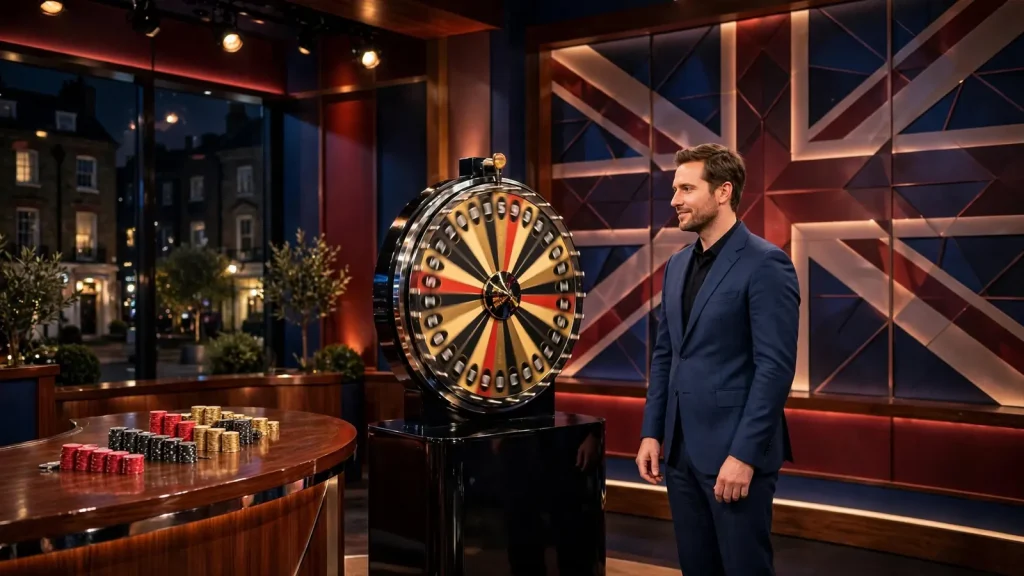
Each production can offer different betting choices, timing and result mechanics, so compare its rules rather than judging the studio presentation.
How Online Casino Game Shows Work
A live casino game show combines a streamed studio presentation with a gambling interface. A presenter, set and sequence of on-screen events give the session the shape of a show, while the casino interface lets you place bets on eligible outcomes. The exact rules depend on the individual production: the label describes a style of live casino entertainment, not one standard game with fixed mechanics.
That distinction matters when you compare live casino game shows. Two productions can both feature a host and a live feed yet ask you to make different choices, resolve bets in different ways or move at different speeds. The useful starting point is not the set design or the energy of the presenter. It is the rule structure: what you can bet on, when you can do so, and how each result determines a payout.
The main parts of a session
A session generally has a repeating sequence. The interface opens a betting period, displays the available choices and allows bets to be placed. The host or production then signals that betting has closed, an event takes place, and the result is shown. The interface settles the relevant bets before the next round begins.
Amatic Casinos in the UK: Games and Checks
The stream and the betting interface serve different purposes. The video shows the presentation and outcome; the interface displays selections, bet controls and information about your own play. Depending on the production, some details may also appear as graphics within the broadcast. You should be able to follow the result through the game’s rules and interface rather than relying on a presenter’s commentary to infer whether a bet won.
This is a useful first test of clarity. Can you tell when betting is open? Is it obvious when it closes? Can you identify the result and see how it maps to your selection? If any link in that sequence is hard to follow, the show may feel confusing even when its underlying rules are simple.
The host provides presentation, not a substitute for the rules. A lively delivery can make a round more engaging, but it does not change what a bet means or how it is settled. Treat the game information as the authority for those details. The studio can add atmosphere. The rules do the accounting.
Slot Providers and UK Casino Guides · New Online Casino Sites in the UK: Games and Offers
What you are actually betting on
In a conventional casino game, the central action may be a card draw, a spin or a roll. A game-show format can frame its central event as a larger on-screen reveal or a sequence of events. The betting options might relate to the main result, a feature within the round or another outcome defined by that particular game. There is no single menu of bets shared by every show.
Read each option as a specific claim about what will happen. The label alone may not explain all the conditions. Check whether the selection refers to one outcome, a group of outcomes, an order, or a feature that may occur as part of a round. Also note whether a result can qualify for more than one category and how the game handles that overlap. These details affect settlement, not just presentation.
The paytable or rules panel is where to look for the relationship between a selection and its return. Check which outcomes are covered, what payout applies to each, and whether any special event changes the settlement. A displayed return is not a promise that an outcome will occur; it describes what the rules pay if the qualifying result happens.
It is also worth separating the chance of an outcome from the payout attached to it. A larger stated return does not, by itself, tell you how likely the outcome is. Likewise, a frequently appearing result is not automatically the more valuable bet. To compare options sensibly, you need the complete rules and a clear understanding of the possible outcomes, not just the most prominent number on screen.
Timing and decision points
The betting window is one of the clearest ways to understand a show’s rhythm. It determines how long you have to review the available choices and place a bet before the event begins. A longer window may give you more time to read the interface; a shorter one may make the session feel brisk. Neither is inherently better. The useful measure is whether you can make sense of the options without rushing.
Watch how the game signals transitions. There should be a visible or audible distinction between the period when bets can be placed and the period when they are no longer accepted.
Watch how the game signals transitions. There should be a visible or audible distinction between the period when bets can be placed and the period when they are no longer accepted. If the show includes several stages within a round, notice whether choices are made once or whether another decision point appears later. Do not assume that every production follows the same sequence just because the broadcasts look similar.
The pace between rounds also shapes the experience. Some of the time may be spent explaining choices, presenting the event or displaying the result. Consider whether that rhythm gives you enough time to follow the game and whether the screen remains understandable while the host is speaking. A fast-moving presentation can be entertaining, but speed is not a measure of fairness or value.
A practical comparison is to trace one round from beginning to end: find the point at which betting opens, identify the available selections, note when the event starts, then follow the result through settlement. This simple exercise reveals more about how a show works than a promotional description does.
Reading the interface
The interface should make the important information legible alongside the live feed. Look for the available bet types, the amount selected, any relevant payout information, the status of the betting window and a record of the outcome. These elements help you distinguish the game’s mechanics from its presentation.
A broadcast may use graphics, animations or sound cues to make an event easier to follow. Those are presentation tools. The underlying result still needs to be interpreted according to the published rules. If an animation suggests a result but the rules define the outcome differently, the rules explain how the bet is settled.
No-Limit Online Casinos in the UK: What It Means · Barcrest Online Casinos in the UK: What Listings Confirm
It can help to notice which information stays on screen and which appears only briefly. If you need to consult a paytable, can you do so without losing track of the round? Are the betting controls separate from the video? Does the result remain visible long enough to understand the settlement? These are usability questions, not judgments about the odds.
The stream itself may also affect how easy a session is to follow. A stable picture and clear audio make it easier to observe the event and hear the host. If the video pauses or falls behind the interface, avoid assuming that what you see on screen is the same as the game’s official state at that instant. Use the status and result information provided within the game to follow its progress.
What “live” means here
“Live” refers to the use of a real-time broadcast presentation rather than a purely animated sequence generated on your device. It does not mean that every part of the experience is a conversation with the host, or that the presenter decides the result. The host guides the session; the game’s stated rules determine how outcomes and bets are handled.
The broadcast element can make a round feel more immediate because you watch events unfold as they happen in the studio. At the same time, the betting interface remains structured: it presents the available choices and records the bets that can be settled under the game rules. Keep those roles distinct when you assess a show. The studio provides the spectacle; the interface and rules define the transaction.
Regulatory Context
In Great Britain, the Gambling Commission oversees commercial gambling. An operator must hold a UKGC licence to offer remote gambling to consumers.
The regulatory context is separate from the format. In Great Britain, the Gambling Commission oversees commercial gambling, including remote gambling offered to consumers, even when key equipment is located elsewhere. It issues operating licences to businesses and personal licences to relevant individuals. That explains who regulates the activity; it does not make every live show identical or establish how a particular game works.
A comparison framework
When you assess the best online casino game shows for your own preferences, “best” needs a criterion. One show might suit you if you value simple choices; another might be easier to follow if its rules and round transitions are especially clear.
Use a compact checklist:
| What to compare | What to look for |
|---|---|
| Bet choices | Whether each option has a clear definition and result condition |
| Round sequence | How betting, the event and settlement follow one another |
| Timing | Whether the betting window gives you time to understand the choices |
| Rules display | How easily you can find payout and settlement details |
| Result clarity | Whether the outcome is easy to identify and connect to your bet |
| Presentation | Whether the host, graphics and sound help you follow the round |
| Interface | Whether bet controls and game information remain understandable |
This table is not a ranking. It is a way to make unlike shows easier to compare. If your priority is clarity, give more weight to the rules display and result settlement. If you prefer a faster session, pay attention to the time between rounds and the length of betting windows. If the presentation is your main interest, consider whether it supports the game or distracts from its mechanics.
A useful test is to explain a round in plain language after watching it: what could be selected, what happened, and why the result paid or did not pay. If you cannot do that, revisit the rules before betting. A show’s energy can hold your attention while leaving the mechanics obscure; those are separate qualities.
Finally, do not treat the word “show” as evidence that a game offers more control, better odds or a particular kind of outcome. It describes the presentation style. The available bets, round structure and settlement terms belong to the specific game. Compare those features on their own merits, then decide whether the format suits the way you want to follow a live casino session.
Our top casino picks for the UK
- ZombillionBonus: Welcome Pack 250% up to £4000 + 200 FS · Payout speed: 1-3 business days
- SlotoSportBonus: 500% up to £ 10 200+ 777 FS · Payout speed: 1-3 business days
- NightWinBonus: £900 + 400 free spins · Payout speed: 1-3 business days
- DieselwinBonus: Welcome Pack 250% up to £4000 + 200 FS · Payout speed: 1-3 business days
- SpinFormulaBonus: 550% Up To £15,000 + 550 FS · Payout speed: 1-3 business days
- NightLuckBonus: Welcome Pack + 805% Up To 6400€ + 280 FS · Payout speed: 1-3 business days
- JetsetspinsBonus: 200% Bonus + 100 Free Spins + Free Royal Wheel · Payout speed: 1-3 business days
- BritsinoBonus: Welcome Package – Get your £2,200 + 2,000 FS · Payout speed: 1-3 business days
What to Check at a Casino Offering Live Shows
A live show can attract you to a casino, but it is the operator that handles your account, deposits, withdrawals, bonus terms and customer support. Assess those parts separately from the entertainment. A useful comparison table has columns for the licence, access to the show, account conditions, payment rules, bonus terms and safer-gambling tools. The strongest choice depends on which of those matters most to you; a large lobby does not settle the question.
Confirm the operator’s UKGC licence
For real-money remote gambling offered to consumers in Great Britain, the operator must hold a UKGC licence. This applies even if the business or the equipment it uses is based elsewhere. The UK Gambling Commission regulates commercial gambling in Great Britain, while Northern Ireland has a different legal framework.
Confirming Operator
- Check the casino’s legal name and licence details on the Gambling Commission Public Register
- Verify the operator holds a valid UKGC licence
- Distinguish the casino from the game or technology supplier
Check the casino’s legal name and licence details against the Gambling Commission Public Register. Do not treat a logo, a search result, or the presence of a live show in a lobby as proof of authorisation. A listing is a starting point; the register is where you can check whether the business holds the relevant licence.
Also distinguish the casino from any company supplying its games or show technology. A supplier’s own licence does not replace the operator’s responsibility for your account. You need to know which licensed business would take your deposit, process a withdrawal and answer a complaint.
If the casino’s ownership or trading name is unclear, pause before registering. Compare the name in the terms with the business shown on the register. An operator should not become harder to identify precisely when you are trying to establish who is accountable.
Check whether the show is accessible to you
A casino may advertise live shows without making every item available to every customer at every moment. Before depositing, look for the show in the casino’s own lobby and check whether you can open its information and access screens. Availability can change, so rely on the operator’s current listing rather than an old review or a general claim about its catalogue.
Read the access conditions alongside the lobby entry. Check whether you need to sign in, whether the show is restricted by location or account status, and whether the operator sets any participation conditions. These are practical questions about access, not judgments about which show is better.
If you are using a mobile device, check the operator’s site in the browser you intend to use. Look for clear navigation back to your account and the terms, and make sure the relevant information remains readable on a small screen. A polished preview is not much use if you cannot find the rules once signed in.
EGT and Amatic Online Casinos in the UK
Do not infer that a show is available because the casino offers live content generally. Confirm the specific listing before making a payment decision. If you cannot establish what is available, choose on the basis of the services you can verify rather than an assumed catalogue.
Understand who handles your money and account
The operator, not the presenter or software supplier, is responsible for handling your deposit and paying any winnings under its terms. Before funding an account, identify the business named in the cashier and account terms. Check that the payment rules, withdrawal process and customer-support route all point back to the same licensed operator.
Read the payment conditions before choosing a method. UK remote gambling must not be funded by credit card, including through an e-wallet topped up with a credit card. If a payment option is unclear about its funding source, do not assume it is acceptable; check the operator’s explanation.
Look for the operator’s rules on withdrawals, account verification and payment-method restrictions. The important comparison is not a headline promise but whether the terms explain what information may be requested, how a withdrawal is handled and where you can ask for help. Do not rely on an offer banner to explain the full process.
An operator must verify your age before allowing you to deposit, and it must check your name, address and date of birth before your first deposit. Expect account checks to be part of the process. If the registration flow does not make clear which business is collecting your details or why it needs them, resolve that before proceeding.
Attention UK remote gambling must not be funded by credit card, including through an e-wallet topped up with a credit card.
Read the bonus terms as a separate decision
A live-show casino may advertise promotions, but a bonus is not automatically a benefit. Compare the amount or form of the offer only after reading the conditions attached to it: eligibility, expiry, game restrictions, withdrawal rules and any effect on access to other products. If the terms are difficult to locate or do not explain how winnings are treated, you cannot make a sound comparison.
For bonuses offered to UK players, wagering requirements on bonus funds are capped at 10× under the UK Gambling Commission’s rules, which took effect on 19 December 2025. Check how the operator describes the requirement and what funds it applies to. The cap does not remove the need to read the rest of the conditions.
Do not assume that a promotion linked to a casino account applies to a live show. The offer terms should say which products count, and whether a particular activity contributes to any requirement. If they do not make that clear, ask customer support before accepting the offer.
Keep casino promotions distinct from bundled sportsbook offers. UK operators must not provide mixed-product promotional bonuses that combine casino incentives with sportsbook free bets. A clear offer should let you understand which product it concerns and what rules govern it.
Amatic Online Casinos in the UK: Games and Operators
Look for usable account controls
All UKGC-licensed online operators must prompt customers to set a financial limit before their first deposit. The prompt should be part of the account process, not an obscure setting you are expected to discover later. If you reduce a limit, the operator must apply that reduction immediately.
Check whether the account area makes your limits easy to find and review. Consider whether you can understand the distinction between the controls available and the conditions for changing them. The point is not to find the casino with the longest list of tools, but to see whether the controls you need are visible and usable.
GamStop has been mandatory for all GB-licensed online operators since 31 March 2020. Check that the operator provides access to it and understand that self-exclusion is a protection measure, not a temporary bonus setting. If gambling is causing harm, use the relevant support options rather than trying to manage the problem by switching between casinos.
Compare terms, support and clarity
Before opening an account, find the terms, privacy information, complaints procedure and customer-support contact route. You should be able to identify how to raise an issue about a deposit, withdrawal, account restriction or promotion. Compare how directly the operator explains these processes, not merely how prominently it advertises the live content.
Comparison Checklist
- Check if the operating business holds a relevant UKGC licence
- Ensure the specific show is currently listed and accessible
- Confirm funding and withdrawal conditions are clear and permitted
- Verify that identity checks are explained before depositing
- Confirm that financial limits can be set before your first deposit
- Identify how to contact the operator and make a complaint
Read the rules that apply to the account as a whole, then check any show-specific conditions separately. If two pages appear to conflict, ask the operator which terms govern your situation and keep a record of the response. Clear answers are more useful than broad assurances.
You can use a simple comparison table:
| Check | What to establish |
|---|---|
| Licence | Does the operating business hold the relevant UKGC licence? |
| Show access | Is the particular show currently listed and accessible to your account? |
| Payments | Are the funding and withdrawal conditions clear, and is the funding method permitted? |
| Verification | Are identity checks explained before you deposit? |
| Bonuses | Are eligibility, product restrictions and wagering terms easy to understand? |
| Account controls | Can you set a financial limit before your first deposit and find it later? |
| Support | Can you identify how to contact the operator and make a complaint? |
This table helps separate a casino’s entertainment from its operating standards. A venue may score well on access but poorly on unclear terms; another may be easier to assess because its account rules are straightforward. The better fit depends on the criterion you value, not on a single “best” label.
Treat missing clarity as a reason to wait
You do not need to resolve every uncertainty by depositing. If the licence identity, access conditions, payment rules or bonus terms are hard to verify, wait for a direct answer. Do not use an offshore casino as a substitute: offshore operators sit outside the UKGC framework and do not provide the same UK regulatory protections.
A careful choice is not necessarily the casino with the most prominent live-show promotion. It is the operator whose licence, account responsibilities and conditions you can understand before you commit money. That is the useful comparison. Showreels can wait.
Comparing High-Energy Live Show Formats
A high-energy live casino show can look like the obvious choice when you want lively presentation rather than a restrained table-game atmosphere. But “energetic” is not one measurable feature. It can mean a quick-moving broadcast, a prominent presenter, busy visuals or frequent changes in what is happening on screen. Decide which of those you actually enjoy before comparing formats; otherwise, the loudest presentation may win by default.
Amatic Online Casinos in the UK: Games and Checks
A useful comparison separates pace from spectacle. A show may have a colourful set and animated graphics yet leave plenty of time between moments of action. Another may feel brisk because the presenter keeps the conversation moving, even if the screen itself is less crowded. Neither is automatically better. If you want a format that feels lively without demanding constant attention, clarity and rhythm may matter more than visual intensity. If you prefer an immersive broadcast, staging and sound may carry more weight.
Compare the experience, not just the volume
| Criterion | What to notice | Why it matters |
|---|---|---|
| On-screen pace | How quickly the presentation moves between stages | A rapid rhythm can feel exciting, but may leave less room to follow what is happening |
| Visual density | How much movement, text and animation compete for attention | A busy screen can add spectacle or make key information harder to pick out |
| Presenter’s role | Whether the host mainly explains, reacts or drives the presentation | Some viewers enjoy a strong on-camera personality; others prefer the action to stay central |
| Clarity | Whether rules, outcomes and current choices are easy to understand | Energy is less enjoyable when you have to work to keep track |
| Waiting rhythm | How the show handles quieter moments | The gaps between major moments can shape the overall feel as much as the peaks |
Use the table as a set of questions, not a scorecard with a universal winner. You might rate each criterion according to your own preference, then compare the formats you are considering. A format that scores highly for spectacle could score lower for legibility. That is a trade-off, not a defect.
Look for a pace you can follow
Fast pacing can make a broadcast feel immediate, but speed alone does not make it engaging. Notice whether you can follow the sequence without having to concentrate on every second. If explanations are easy to catch and transitions feel natural, a lively rhythm may suit you. If important information flashes by while several visual elements compete for attention, a slower or cleaner presentation may be more comfortable.
It also helps to distinguish a quick sequence from a consistently fast show. A format can build towards energetic moments while giving you calmer stretches in between. Another may maintain a heightened tone throughout. Think about which pattern you would rather watch over a longer session. A constant stream of stimulation can become tiring; repeated pauses may feel flat if you want continuous momentum.
Understanding High-Energy Formats
High-energy live casino shows can vary significantly in how they deliver excitement. It can mean a quick-moving broadcast, a prominent presenter, busy visuals, or frequent changes in what is happening on screen.
Weigh the host and the production
The presenter can set the tone, but their prominence is a matter of taste. A host who reacts frequently may make the experience feel more sociable and theatrical. If you would rather focus on the game’s progress, that same level of commentary might distract. Consider whether the presenter helps you understand what is happening or simply adds performance around it.
Production design matters in much the same way. Lighting, graphics, sound and camera movement can create a sense of occasion. They can also compete with explanations or make the screen feel crowded. Compare how these elements work together rather than counting them. A polished presentation is not necessarily a clear one, and a simpler set is not necessarily dull.
Make “best” personal
When deciding between high-energy formats, choose the criterion that matters most to you. For a viewer who wants momentum, pace may come first. For someone who values easy-to-follow presentation, clarity may be the stronger measure. If personality is central to the appeal, the host’s style may outweigh the set or graphics.
Amatic Games at UK Casinos: Suppliers and Play
The best fit depends on your priorities, not on a format’s reputation for being lively. Before committing to a session, use any available preview or free-play mode to judge the rhythm and presentation for yourself. Pay attention to whether the show feels engaging after the initial impression has passed. A dramatic opening is easy; sustained enjoyment is the better test.
What Makes a Live Casino Game Show Different
A live casino game show combines the visual language of entertainment with the chance-based structure of casino play. Its distinction is less about a particular rule or piece of equipment and more about how the experience is presented. Instead of centring the screen on a conventional table and its betting layout, a show-led format puts performance, pacing and a shared viewing experience closer to the foreground.
That difference changes what you notice. In traditional live-dealer content, attention tends to settle on the table, the dealer’s actions and the sequence of a familiar casino game. A game-show presentation can give more prominence to a presenter, a set, on-screen graphics and moments of reveal. The interface still has to communicate the wager and outcome, but the show’s staging may make it feel closer to watching a hosted entertainment programme than observing a table game.
Presentation vs Mechanics
The visual treatment and the game’s mechanics are separate things. A lively set or a prominent presenter does not change the underlying rules or the chance-based nature of the play.
“May” matters here. The category is broad, and the label alone does not tell you how any particular production looks or plays. Some experiences can lean heavily on a presenter and spectacle; others may use a more restrained presentation. Nor does a lively set mean the underlying result is less dependent on chance. The visual treatment and the game’s mechanics are separate things.
Performance is part of the presentation
A host can give a live game show a social, human focal point. Their role may be to explain what is happening, keep the pace moving or address viewers through the broadcast. That creates a different atmosphere from a format where the dealer’s work is the central event. You are not simply watching a hand or spin unfold; you are also following a performance designed to make the sequence legible and engaging.
This can make the experience feel more accessible to someone who finds a traditional casino table formal or unfamiliar. A presenter can frame events in conversational terms, while visual cues help direct attention. But presentation should not be confused with instruction tailored to you, or with a promise that the rules are simpler. Before staking money, you still need to understand what your choices do and how an outcome is determined.
The entertainment layer can also affect your sense of pace. Music, graphics, announcements and a host’s delivery may make transitions feel more theatrical than they would at a standard live table. That can be enjoyable if you want a more animated screen. If you prefer quiet concentration and minimal interruption, the same production choices may feel like clutter.
The screen can carry more of the experience
In a conventional table format, the physical layout often explains the game: you can see the table, the dealer and the relevant betting areas. A show-led format may rely more heavily on screen design to organise information. Labels, animations and highlighted areas can help you follow the action, but they also compete for attention with the host and the visual set.
Amatic Casinos in the UK: How Game Access Works
A useful way to judge the difference is to separate spectacle from clarity. Ask yourself whether you can readily identify the available decisions, the amount at risk and the point at which an outcome is settled. A polished broadcast is not automatically a clear one. Equally, elaborate graphics do not necessarily make a game harder to follow; they may be doing useful explanatory work. The test is whether the presentation helps you understand what is happening without obscuring the wagering.
The format may also feel less like a private session and more like a broadcast shared with other viewers. That is a matter of atmosphere, not evidence that players influence one another’s results. The presence of a presenter or an audience-facing style does not, by itself, alter the chance-based nature of play. Treat the social tone as part of the entertainment, not as a signal about your prospects.
Different from a live table, not a different promise
A live casino game show is best understood as a presentation category rather than a guarantee of a particular experience. The label does not establish how interactive the show is, what decisions are available, how quickly rounds proceed or what visual features appear. Those details depend on the specific title and its implementation.
Amatic Slots at UK Online Casinos: How Access Works
That is why comparisons work best when you name the criterion. For atmosphere, look at how much the experience depends on hosting and production. For ease of following the action, focus on how clearly the screen explains decisions and outcomes. For a calmer session, consider whether frequent commentary and visual effects suit you. There is no universal winner: a format that feels engaging to one viewer may be distracting to another.
The underlying distinction is straightforward. Traditional live casino content often puts the game table and its procedure at centre stage; game-show content gives the broadcast itself a more prominent entertainment role. Neither approach is inherently more transparent, more favourable or more suitable for every player. The better fit is the one whose presentation you can follow and whose pace you actually want—not the one with the loudest set.
Are Amatic casinos safe and regulated in the UK?
Amatic is a software supplier, not a consumer-facing casino, and it holds a UK Gambling Software licence. You place bets through a casino operator, so check that the operator is licensed by the UK Gambling Commission.
How does the UK’s 10× wagering cap affect Amatic casino bonuses?
For bonus funds, UK rules cap wagering requirements at 10 times the bonus amount. The casino operator sets the bonus terms, so check those terms before accepting an offer.
What is the new UK slots stake limit and how does it affect Amatic games?
The online slot stake limit is £5 per game cycle for players aged 25 and over, and £2 for those aged 18 to 24. These limits apply to Amatic slots played at UK-licensed casinos.